GCSE Revision Schedule Generator
Personalized Revision Plan
Create an effective revision schedule based on your specific needs. This tool incorporates spaced repetition principles to maximize retention.
It’s December. You’ve got six months until your first GCSE exam. Or maybe it’s March, and panic is setting in because you haven’t opened a textbook in weeks. Either way, you’re asking: how is the best way to revise for GCSE? The truth? There’s no magic formula. But there are proven methods that actually move the needle - if you use them right.
Start with what you know you struggle with
Don’t start revising by reading your notes from top to bottom. That’s busywork, not revision. The most effective revision begins with honesty. What topics do you freeze up on during class? Which past papers do you avoid? Those are your weak spots. They’re not flaws - they’re just gaps in your knowledge. And gaps are fixable.Take Maths. If you keep messing up quadratic equations, don’t skip to trigonometry. Block out 45 minutes, grab your textbook, and work through five problems. Then five more. Then try a past paper question on the same topic. If you get it right, great. If you don’t, write down exactly where you got stuck. Was it the sign? The factorising? The calculator input? That’s your next target.
Science? If you mix up photosynthesis and respiration, make a simple table. One column for each process. List inputs, outputs, where it happens, and why it matters. Then test yourself without looking. Repeat until you can do it from memory. This isn’t about memorising - it’s about understanding the difference.
Use active recall, not passive reading
Reading over your notes feels productive. It’s not. Your brain tricks you into thinking you know it because the words look familiar. That’s called the illusion of competence.Active recall means forcing your brain to retrieve information without prompts. Flashcards are the simplest tool. Write a question on one side - ‘What are the three states of matter?’ - and the answer on the other. Don’t look. Try to answer. Then flip. If you got it right, put it in the ‘mastered’ pile. If not, put it back in the ‘work on’ pile. Do this daily. Even ten minutes a day builds real memory.
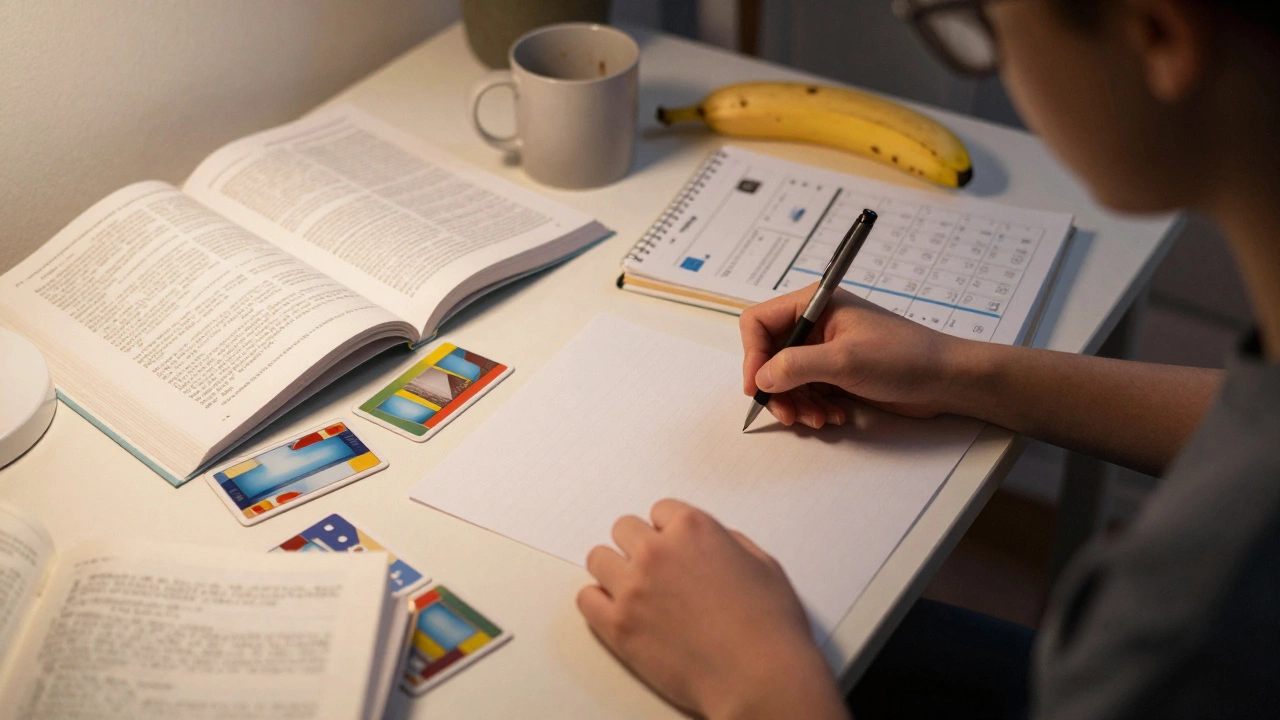
Or try the blank page method. After studying a topic, close your book. Take a blank sheet of paper. Write down everything you remember - definitions, diagrams, steps, examples. Then check your notes. The gaps? That’s where you need to focus. This isn’t just revision - it’s training your brain to recall under pressure, just like in the exam.
Space out your revision - don’t cram
Cramming the night before doesn’t work. Not because you’re lazy - because your brain doesn’t store information that way. Studies show that spacing out learning over days and weeks leads to 20-30% better long-term retention.Here’s how to do it: Use a calendar. Pick one topic per day. Study it on Monday. Review it on Wednesday. Then again on Friday. Next week, test yourself again. By the time the exam rolls around, you’ve seen it five or six times - not in one marathon session, but in small, repeated doses. Your brain treats this as important. It keeps the information.
Apps like Anki or Quizlet can automate this for you. But even a printed calendar works. Just mark the days. Stick to them. If you miss one, don’t panic. Just pick it up again the next day. Consistency beats intensity every time.

Practice past papers like real exams
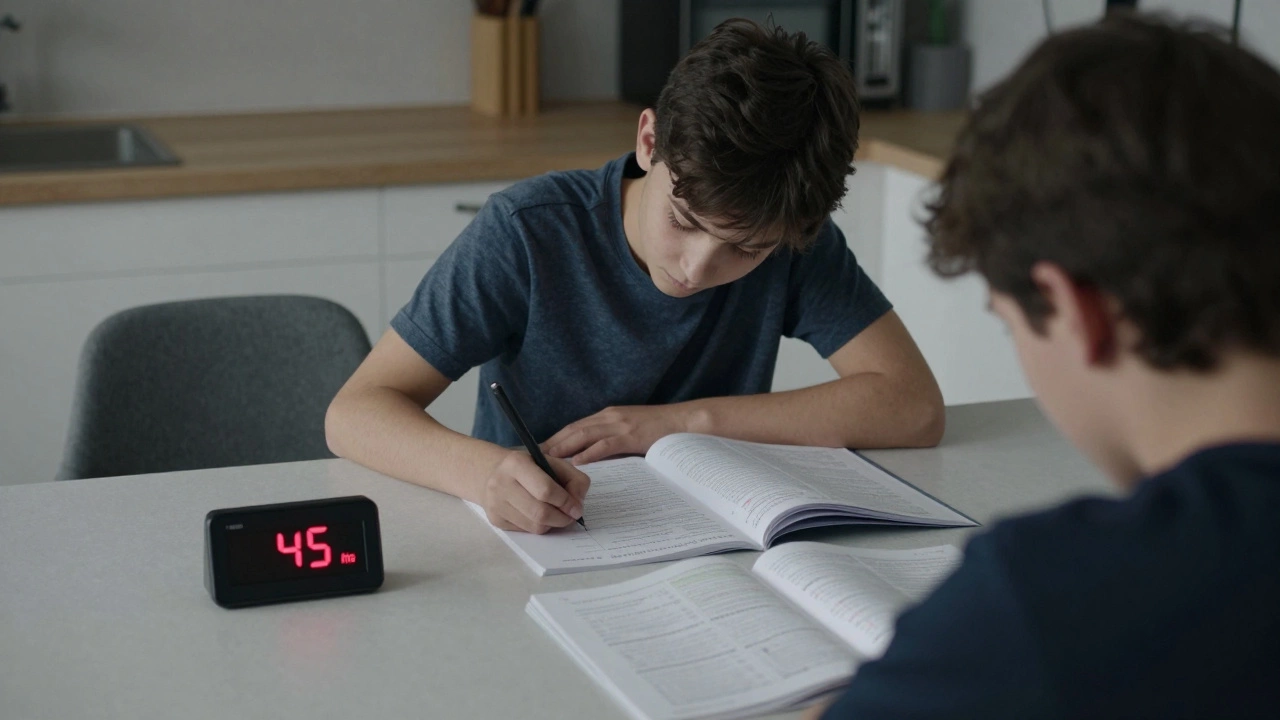
Past papers aren’t optional. They’re the closest thing to the real thing. But most students treat them like homework - open book, no timer, checking answers as they go. That’s useless.Do this instead: Set a timer. Sit at a quiet table. No phone. No music. No snacks. Treat it like the real exam. When the time’s up, stop. Even if you haven’t finished. Then mark it properly. Not just ‘right’ or ‘wrong’. Look at the mark scheme. Where did you lose marks? Was it not explaining enough? Missing a key term? Writing in paragraphs instead of bullet points? That’s your feedback loop.
Do at least one full past paper per subject every two weeks in the final three months. By exam season, you’ll know the format inside out. You’ll know how long each question should take. You won’t panic when you see the paper.
Teach it to someone - even if they’re not listening
The Feynman Technique isn’t fancy. It’s simple: If you can’t explain something in plain language, you don’t understand it. Try this: After studying a topic, pretend you’re teaching it to a 12-year-old. Use no jargon. No fancy words. Just simple sentences. If you stumble, you’ve found a gap.You don’t need a real audience. Talk to your pet. Talk to the wall. Record yourself on your phone. Play it back. If you sound confused, you are. Go back. Simplify. Rewrite. Try again. This forces your brain to organise the information clearly - exactly what examiners want to see.
Build a revision schedule that fits your life
A perfect revision plan means nothing if you never stick to it. The best schedule is the one you’ll actually use.Start by mapping out your week. What days are busy? Football practice? Piano lessons? Family dinners? Block those out. Then find the gaps - 30 minutes after school, 45 minutes before bed, Saturday morning. That’s your revision time.
Don’t try to do six subjects in one day. Pick two. One in the morning, one in the evening. Rotate them. Monday: Maths and Biology. Tuesday: English and History. Wednesday: Chemistry and Geography. Repeat. Keep it simple. Keep it realistic.
And include breaks. Seriously. Every 45 minutes, walk away. Stretch. Look out the window. Get a drink. Your brain needs downtime to process what it’s learned. Sitting for three hours straight doesn’t make you smarter - it just makes you tired.
Sleep, food, and movement matter more than you think
You can’t revise effectively if you’re running on fumes. Sleep isn’t wasted time - it’s when your brain files away what you’ve learned. If you’re pulling all-nighters, you’re sabotaging your memory.Shoot for 7-8 hours a night. Even on weekends. If you’re sleeping less than six, you’re not helping your grades. You’re hurting them.
Food matters too. Sugary snacks give you a quick buzz, then a crash. Protein, whole grains, and fruit keep your energy steady. A banana and peanut butter before revision? Better than a chocolate bar. Water? Drink it. Dehydration slows your thinking.
And move. Walk for 20 minutes after dinner. Dance to one song. Do five push-ups. Movement boosts blood flow to your brain. It reduces stress. It makes you feel in control. You don’t need the gym. Just get up and go.
What to avoid
Here’s what doesn’t work - and why:- Highlighting everything in your notes - you’re just colouring, not learning
- Watching YouTube revision videos without pausing to test yourself - passive watching doesn’t stick
- Revising in bed - your brain associates bed with sleep, not focus
- Comparing your progress to others - everyone’s pace is different
- Waiting until you ‘feel ready’ - you won’t feel ready until you’ve done the work
Focus on action, not feeling. Do the work, even when you don’t feel like it. Progress comes from consistency, not motivation.
Final tip: Know your exam board
Edexcel, AQA, OCR, CCEA - they all write exams differently. A question that’s worth 3 marks on AQA might be worth 6 on Edexcel. The mark schemes vary. Know yours.Go to your exam board’s website. Download the specification. Look at the command words: ‘Describe’, ‘Explain’, ‘Evaluate’. What do they want? What’s the difference? Practice answering each type. Your teacher can help. Or ask your school for past papers with mark schemes.
Knowing your exam board means you know exactly what to expect. That’s half the battle won.
How many hours should I revise for GCSE each day?
There’s no magic number. Most students find 1-2 hours a day, spread across two subjects, works well. That’s about 10-14 hours a week. If you’re in Year 11 and exams are close, you might increase to 2-3 hours on weekdays and 4-5 on weekends. But quality matters more than quantity. One focused hour with active recall is better than three hours of mindless reading.
Is it too late to start revising for GCSEs?
No. Even if you’ve only got six weeks left, you can still make big gains. Focus on your weakest topics first. Use active recall and past papers. Don’t try to cover everything. Cover the high-mark, high-frequency topics. A few solid weeks of smart revision can lift your grade by a full band. Start today - not tomorrow.
Should I use revision guides or stick to my class notes?
Use both. Your class notes are your foundation - they reflect what your teacher thinks matters. Revision guides like CGP or Pearson are great for simplifying complex topics and showing exam-style questions. Use the guide to clarify, then test yourself using your notes. Don’t just read the guide - turn it into flashcards or blank-page tests.
How do I stay motivated when revision feels boring?
Change how you revise. If flashcards feel dull, try teaching the topic out loud. If reading is boring, turn it into a quiz with a friend. Reward yourself after a session - 10 minutes of TikTok, a walk, your favourite snack. Link effort to small wins. Also, remember why you’re doing this. Not for your parents. Not for your teacher. For your future self. The version of you that walks into the exam room calm, prepared, and in control.
What if I fail a past paper?
Failing a past paper is the best thing that can happen. It shows you exactly where you’re weak - before the real exam. Don’t see it as failure. See it as a diagnostic. Mark it properly. Write down every mistake. Then make a plan to fix each one. Do one topic at a time. You’ll be surprised how fast your score improves when you target your gaps.
If you’ve read this far, you’re already ahead of most students. The best revision isn’t about genius. It’s about strategy, consistency, and knowing what actually works. Start small. Stick to it. And trust the process.