Early Years Learning Bridge
Many see childhood play as just "fun," but it is actually the hardest work a child does. Select an activity to see the hidden educational purpose and the brain skills being developed.
What's happening in the brain?
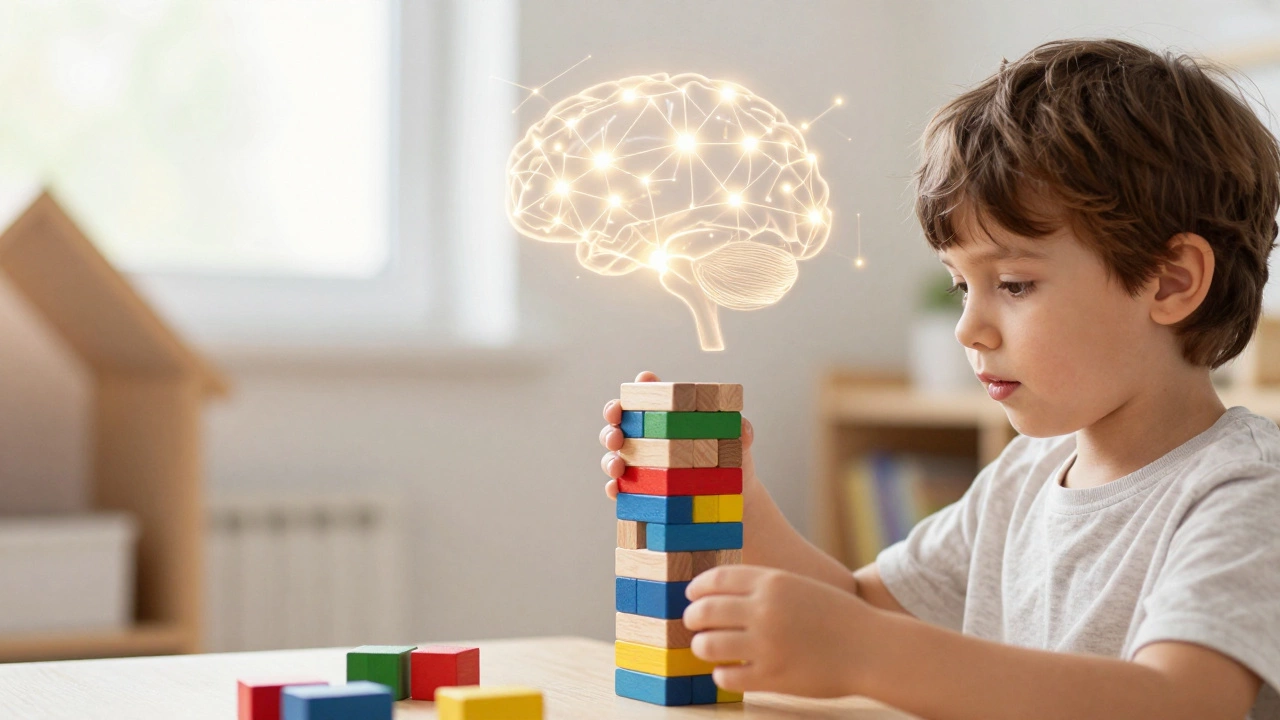
Building a tower isn't just about stacking. It's a real-time physics experiment.
- Spatial Awareness: Understanding how shapes fit together and balance.
- Problem Solving: Figuring out why a tower fell and how to stabilize it.
- Fine Motor Skills: Developing the precision movements needed for later writing.
- Resilience: Learning to try again after a structure collapses.
What's happening in the brain?
Playing "Shop" or "Doctor" is a sophisticated mental exercise in symbolism.
- Symbolic Thought: Using a leaf as "money" (foundation for abstract math/letters).
- Empathy: Stepping into someone else's role to understand different perspectives.
- Numeracy/Literacy: Scribbling prices or lists mimics real-world academic skills.
- Executive Function: Planning the "plot" of the game and remembering roles.
What's happening in the brain?
Finger painting and scribbling are the prerequisites for formal literacy.
- Sensory Integration: Processing textures, smells, and colors to build neural connections.
- Hand-Eye Coordination: Training the brain to guide the hand with precision.
- Self-Expression: Communicating emotions before they have the words to describe them.
- Creativity: Experimenting with cause-and-effect (mixing blue and yellow).
Think back to your own childhood. Do you remember the smell of finger paints, the chaos of a sandbox, or the intense focus of building a tower that was slightly too tall? Many people mistake the early years of a child's life for a simple "waiting room" before real school begins. They see it as childcare-a way to keep kids safe while parents work. But the reality is far more intense. Between birth and age five, a child's brain is essentially a sponge on steroids, forming millions of neural connections every single second. If we treat these years as just a gap to fill, we miss the most critical window for human development.
The true goal isn't to teach a four-year-old how to pass a chemistry test or memorize historical dates. It's about building the architecture of the brain. When we talk about early years education, we are talking about setting the foundation for everything that follows. If the foundation is shaky, the rest of the building-no matter how expensive the materials are later in life-will always be unstable.
| Feature | Basic Childcare | Early Years Education |
|---|---|---|
| Primary Goal | Safety and supervision | Holistic development and learning |
| Approach | Routine-based / Reactive | Intentional / Pedagogy-driven |
| Focus | Physical needs (meals, naps) | Cognitive, social, and emotional growth |
| Outcome | Child is kept safe | Child is prepared for lifelong learning |
Building the Social and Emotional Engine
Long before a child can read a sentence, they have to learn how to exist in a world with other people. This is where Social-Emotional Learning is the process of developing self-awareness, self-control, and interpersonal skills comes into play. Imagine a three-year-old trying to take a toy from another child. In a purely custodial setting, an adult might just say "stop it." In an early years educational setting, that moment is a goldmine. It's a chance to teach empathy, negotiation, and emotional regulation.
When children learn how to manage frustration or share a resource, they aren't just "playing nice." They are developing the prefrontal cortex of the brain. This area handles executive function-the ability to focus, plan, and remember instructions. A child who can regulate their emotions at age four is statistically more likely to handle the stress of high school and adult workplaces. It's not about the toy; it's about the brain wiring required to handle conflict.
The Magic of Play-Based Learning
If you walk into a high-quality early years classroom, it might look like a disaster zone to the untrained eye. There are blocks on the floor, water in a tray, and kids dressed as dinosaurs. But this is Pedagogy is the method and practice of teaching, especially as an academic discipline in action. We call this "play-based learning" because for a child, play is the hardest work they will ever do.
Take a simple game of "Shop." The children are practicing Numeracy, which is the ability to understand and work with numbers, by counting coins and pricing items. They are practicing Literacy, the ability to read and write, by scribbling signs and lists. More importantly, they are engaging in symbolic thought-the ability to let one thing represent another. This is the exact mental leap required to understand that a letter "A" represents a sound, or that a number "5" represents five physical objects.
Cognitive Development and the Critical Window
Neuroscience tells us that the brain's plasticity is at its peak during these years. This is when the Synapse, which is the junction between two nerve cells, allowing a signal to pass from one to the other, are firing rapidly. If a child is exposed to a rich language environment, a diverse range of sensory experiences, and supportive relationships, those connections are strengthened. If they are neglected or placed in a sterile environment, those connections can actually prune away.
This is why early intervention is so powerful. If a child has a speech delay or a sensory processing issue, catching it at age three is a game-changer. By the time they hit primary school, the gap between a child with support and one without can be massive. The purpose of early years is to identify these needs early, ensuring that no child starts their formal schooling at a disadvantage.
Preparing for the Transition to Primary School
Many parents worry that their children aren't "academic enough" because they aren't doing worksheets at age four. Here is a secret: worksheets are often the least effective way for a preschooler to learn. The real transition to Primary Education, which is the first stage of formal compulsory education for children, is about confidence and curiosity.
A child who has spent their early years exploring, asking "why?" a thousand times a day, and failing at building a tower only to try again, has developed resilience. Resilience is the engine of academic success. When a child encounters a difficult math problem in second grade, the child who was allowed to struggle and experiment in the early years doesn't shut down. They think, "I'll try a different way," because that's how they learned to navigate the world when they were three.
The Long-Term Impact: The Heckman Equation
If you want proof that this matters, look at the work of James Heckman, a Nobel Prize-winning economist. He studied the long-term effects of high-quality early childhood programs and found that the return on investment is higher for early education than for any other stage of schooling. This isn't just about grades; it's about life outcomes.
Children who receive quality early years support show higher rates of employment, better health outcomes, and lower rates of incarceration as adults. Why? Because the "soft skills"-persistence, empathy, and curiosity-are baked into the brain's architecture during those first five years. You can't simply "add" these traits later in life with a textbook; you have to grow them from the ground up.
Is play just a break from learning?
Absolutely not. For young children, play is the mechanism of learning. Through play, they experiment with physics (gravity, balance), social dynamics (turn-taking, leadership), and language. A child playing with blocks is actually conducting a physics experiment in real-time.
When should formal reading and writing start?
While every child is different, the focus in early years should be on "pre-literacy." This means listening to stories, rhyming, and drawing. Forcing a child to write letters before they have the fine motor skills (developed through play and art) can actually lead to frustration and a dislike of school.
What is the difference between Montessori and traditional early years?
Montessori emphasizes independence and self-directed activity within a prepared environment. Traditional early years might be more teacher-guided. Both aim for development, but Montessori focuses more on the child's individual pace and choice of activity.
How does the home environment impact early years education?
The home is the first classroom. Conversations, reading together, and emotional support at home amplify the work done in a classroom. A "language-rich" home-where adults talk to children and ask open-ended questions-significantly boosts cognitive development.
Can a child be "behind" if they aren't hitting milestones?
Development isn't a straight line; it's a series of leaps. Some children talk early but struggle with motor skills; others are the opposite. However, early years educators are trained to spot patterns. If a child is significantly outside the expected range, early intervention is the best way to get them back on track.
Moving Forward: What to Look For
If you're choosing a setting for a child, don't look for the one with the most colorful worksheets or the one that promises they'll be reading by age four. Look for the one where the children are talking to each other, where there are messy stations for art and water, and where the teachers spend more time asking questions than giving answers. The goal isn't to fill a bucket; it's to light a fire. When we prioritize the purpose of these years-curiosity, social stability, and brain architecture-we give children the best possible start for the rest of their lives.