
Adult Learning Strategy Matcher
Select the option that best describes your current situation for each question.
Skill Acquisition
Mastering a specific task or job function efficiently.
Mindset Shift
Changing deep-seated beliefs, biases, or perspectives.
Autonomy & Growth
Encouraging independent exploration and personal development.
Pragmatic
They want to know "Why do I need this?" and how it helps their daily work.
Resistant/Blind
They may be defensive, unaware of bias, or holding onto old ways.
Curious
They are eager to explore but need resources rather than lectures.
As a Guide
Leverage participants' prior experience through discussion and problem-solving.
As a Catalyst
Create safe spaces for critical reflection and dialectical discourse.
As a Resource Provider
Provide tools and flexibility for them to plan their own path.
Recommended Approach:
Action Plan:
Key Takeaway:
Imagine walking into a classroom where the students have mortgages, children, and full-time jobs. They don't want to be lectured at for an hour; they want answers that apply to their lives right now. If you treat them like high schoolers, they will check out. This is why understanding adult learning theories isn't just academic fluff-it’s the difference between a successful training program and a waste of everyone's time.
While traditional education models focus on dependency and teacher-led instruction, adult education flips the script. Adults bring experience, motivation, and specific goals to the table. To teach them effectively, we need frameworks that respect those differences. Three major theories dominate this space: Andragogy, Transformative Learning, and Self-Directed Learning. Each offers a unique lens on how grown-ups process new information and change their behaviors.
Andragogy: The Core Framework of Adult Education
When people talk about adult learning, they are usually talking about Andragogy. Coined by Malcolm Knowles in the 1970s, this term literally means "the art and science of helping adults learn." It stands in contrast to pedagogy, which is child-focused. Knowles argued that adults are fundamentally different from children in how they approach knowledge.
Andragogy is a theory of adult learning developed by Malcolm Knowles that posits adults are self-directed, experience-rich, and problem-centered learners rather than subject-centered ones. Also known as Adult Learning Theory, it outlines six key assumptions about how mature students operate compared to younger populations.The beauty of Andragogy lies in its practical assumptions. Here is what makes it tick:
- Need to Know: Adults won’t learn unless they understand why they are learning something. You can’t just say, "We’re covering Excel today." You have to say, "This will save you two hours every Friday."
- Self-Concept: As we age, we become more autonomous. We resist being treated as passive recipients. Effective adult education involves collaboration, not dictation.
- Prior Experience: Your life history is your biggest resource. An adult with ten years of sales experience brings a wealth of examples that a fresh graduate doesn’t have. Good teaching leverages this through discussion and case studies.
- Readiness to Learn: Adults learn what they need to cope with real-life tasks. A manager learns leadership skills when they get promoted, not three years before.
- Orientation to Learning: Children learn subjects (math, history). Adults learn solutions to problems. Context is king.
- Motivation: While external pressures (grades, bosses) matter, internal motivators like job satisfaction, self-esteem, and quality of life drive deeper engagement.
If you are designing a workshop, Andragogy tells you to start with the "why," invite participants to share their experiences, and focus on immediate application. It shifts the instructor’s role from "sage on the stage" to "guide on the side."
Transformative Learning: Changing Perspectives
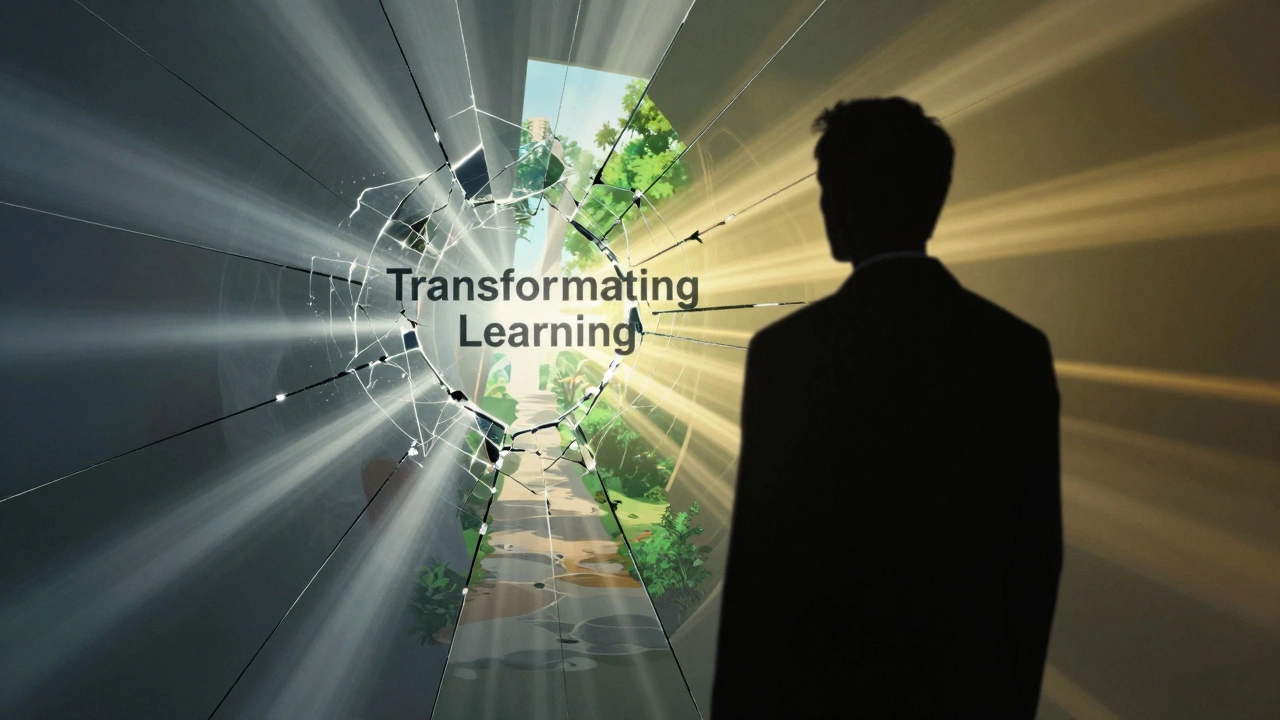
Not all learning is about acquiring new facts. Sometimes, learning is about shattering old beliefs. This is the realm of Transformative Learning, a theory pioneered by Jack Mezirow in the late 1970s. While Andragogy explains how adults learn, Transformative Learning explains why some learning leads to profound personal change.
Transformative Learning is a theory proposed by Jack Mezirow focusing on the process of effecting change in a frame of reference or meaning perspective. It emphasizes Perspective Transformation, where critical reflection challenges deeply held assumptions.Mezirow introduced the concept of "meaning perspectives"-the lenses through which we interpret our world. These include cultural backgrounds, professional biases, and personal values. Most of the time, we assimilate new information into these existing frames without questioning them. But sometimes, we hit a "disorienting dilemma."
A disorienting dilemma could be a career failure, a health crisis, or encountering a culture that contradicts your upbringing. This shock forces us to critically reflect on our assumptions. The learning process then follows a specific path:
- Critical Reflection: You examine your own beliefs and question their validity.
- Dialectical Discourse: You discuss your views with others to test them against different viewpoints.
- Action: You adopt a new, more inclusive, and discriminating perspective and act on it.
In a corporate setting, this might look like a diversity and inclusion training that doesn’t just teach rules but challenges unconscious bias. In higher education, it might involve a sociology course that forces students to re-evaluate their political stance. The goal isn’t just knowledge retention; it’s identity shift. If the learner walks away seeing the world differently, transformation has occurred.
Self-Directed Learning: Taking Ownership
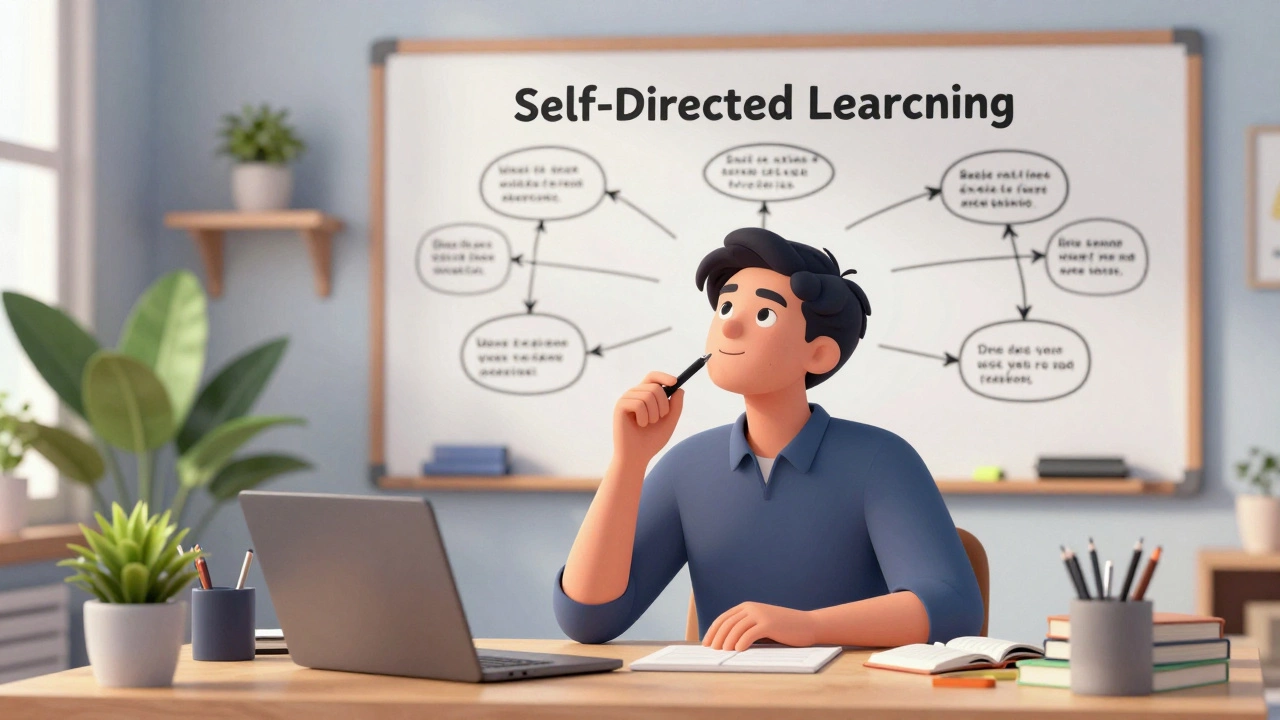
Malcolm Knowles also laid the groundwork for a third crucial theory: Self-Directed Learning (SDL). Often confused with independent study, SDL is much broader. It describes a process where individuals take the initiative, with or without the help of others, in diagnosing their learning needs, formulating goals, identifying resources, and evaluating outcomes.
Self-Directed Learning is a process where learners take primary responsibility for their own learning journey, including planning, executing, and assessing their progress. Championed by Allen Tough and expanded by Knowles, it highlights the autonomy inherent in adult education.Research by Allen Tough in the 1970s showed that most significant adult learning happens outside formal classrooms. People learn by doing projects, reading, and experimenting. SDL acknowledges this reality. It suggests that the more control a learner has over the content, pace, and method, the more engaged they will be.
This theory is particularly relevant in the digital age. With access to online courses, tutorials, and communities, adults rarely rely solely on a single instructor. Instead, they curate their own learning ecosystems. For educators and employers, supporting SDL means providing resources rather than rigid curricula. It involves creating environments where curiosity is rewarded and mistakes are seen as data points for improvement.
| Feature | Andragogy | Transformative Learning | Self-Directed Learning |
|---|---|---|---|
| Primary Focus | How adults learn best | Changing deep-seated beliefs | Learner autonomy and control |
| Key Proponent | Malcolm Knowles | Jack Mezirow | Allen Tough / Malcolm Knowles |
| Role of Instructor | Facilitator/Guide | Catalyst for reflection | Resource provider/Coach |
| Outcome | Practical skill acquisition | Perspective shift | Personal growth & competence |
| Best Used When | Teaching job-specific skills | Addressing bias or complex social issues | Lifelong learning or flexible programs |
Applying the Theories in Real Life
You don’t have to pick just one theory. In fact, the most effective adult education blends all three. Consider a scenario where a company is implementing a new software system.
First, use Andragogy to design the training. Explain why the new software saves time (Need to Know). Ask employees to share their current workflows (Prior Experience). Keep the sessions short and focused on solving specific tasks (Problem-Centered).
Second, anticipate resistance using Transformative Learning principles. Some employees may view the new system as a threat to their expertise. Create safe spaces for them to voice concerns (Dialectical Discourse) and reflect on how technology augments rather than replaces their value (Critical Reflection).
Third, support Self-Directed Learning after the initial rollout. Provide a library of video tutorials, FAQs, and peer mentorship opportunities. Allow advanced users to explore features at their own pace. This ensures that learning continues long after the official training ends.
By weaving these theories together, you create a holistic learning environment that respects the adult learner’s intelligence, experience, and autonomy.
Common Pitfalls to Avoid
Even with good intentions, many organizations fail to implement adult learning principles correctly. Here are a few traps to watch out for:
- Ignoring Prior Knowledge: Assuming adults come in blank slabs. Always assess what they already know to avoid redundancy and boredom.
- Over-Structuring: Providing too much rigidity stifles self-direction. Allow room for questions and detours.
- Neglecting Emotion: Transformative learning can be uncomfortable. Don’t dismiss feelings of frustration or anxiety; address them openly.
- One-Size-Fits-All: Not all adults learn the same way. Mix visual, auditory, and kinesthetic methods to reach diverse learners.
Remember, adult learning is not about compliance; it’s about empowerment. When you align your teaching methods with how adults actually think and behave, you unlock potential that traditional schooling often leaves dormant.
What is the difference between pedagogy and andragogy?
Pedagogy is the art and science of teaching children, where the teacher controls the content and the learner is dependent. Andragogy focuses on adults, who are self-directed, bring prior experience, and are motivated by internal factors and immediate applicability.
Who created the theory of transformative learning?
Jack Mezirow is credited with developing the theory of transformative learning in the late 1970s. He emphasized the role of critical reflection in changing meaning perspectives.
How does self-directed learning differ from independent study?
Independent study often refers to a structured course taken alone. Self-directed learning is a broader process where the learner takes initiative in diagnosing needs, setting goals, finding resources, and evaluating outcomes, often outside formal educational settings.
Can these theories be used together?
Yes, they are complementary. Andragogy provides the structural framework for teaching adults, transformative learning addresses deep belief changes, and self-directed learning supports ongoing autonomy. Blending them creates a robust learning strategy.
Why is prior experience important in adult learning?
Adults accumulate a rich reservoir of experience that serves as a resource for learning. Leveraging this through discussions and case studies makes new information more relevant and easier to integrate, while ignoring it can lead to disengagement.