
Education Path Finder: US vs UK
Not sure which system fits you? Answer these 5 questions to see if you are more aligned with the UK's Specialized Depth or the US's Broad Exploration.
Loading question...
Your Ideal Match:
Quick Takeaways: The Core Differences
- Specialization: The UK system (GCSEs, A-Levels) forces deep focus on a few subjects early. The US system (High School Diploma) keeps a broad range of subjects until college.
- Duration: UK undergraduate degrees are typically 3 years; US degrees are usually 4 years.
- Philosophy: UK education is about academic rigor and depth. US education is about versatility, exploration, and a "liberal arts" foundation.
- Assessment: UK grades often hinge on massive end-of-year exams. US grades are usually a cumulative mix of homework, quizzes, and class participation.
The UK Pipeline: Specialization and the GCSE Hurdle
In the UK, education is a funnel. You start wide, but you narrow down quickly. The first major checkpoint is GCSE is the General Certificate of Secondary Education, a set of examinations taken by students in England, Wales, and Northern Ireland at age 16. For many students, GCSE revision becomes a full-time job during the final year of secondary school. You aren't just learning a subject; you're learning how to pass a specific exam board's criteria.
After the GCSEs, the path narrows further with A-Levels. Unlike American students who take a bit of everything, a UK student might only study three subjects-say, Maths, Physics, and Chemistry. This means by age 18, a UK student often has more deep-dive knowledge in those specific areas than a US college sophomore. If you know exactly what you want to do-like becoming a surgeon or a physicist-the UK system is a fast track. It removes the "fluff" and gets you straight into the hard stuff.
The US Approach: The Liberal Arts Safety Net
The US system operates on a completely different philosophy. High school is designed to keep as many doors open as possible. You'll take English, Math, Science, and Social Studies every year. Even when you get to College (which is the US term for undergraduate university), you aren't locked into a major immediately. You spend the first two years taking "General Education" requirements.
This is a lifesaver for the 18-year-old who has no clue what they want to do with their life. You can take a class in Sociology, a lab in Biology, and a seminar on Ancient History all in the same semester. The US system values the "well-rounded" individual. They believe that a historian who understands basic calculus is a better historian. The downside? You spend more time-and significantly more money-on subjects that might never relate to your eventual career.
| Feature | UK System | US System |
|---|---|---|
| Core Philosophy | Specialization & Depth | Breadth & Exploration |
| Undergrad Duration | 3 Years (usually) | 4 Years |
| Key Qualification | A-Levels / International Baccalaureate | High School Diploma / SAT / ACT |
| Grading Style | High-stakes exams | Continuous assessment (GPA) |
| Subject Choice | Limited (3-4 subjects at A-Level) | Broad (Diverse course load) |
The Pressure Cooker: Exams vs. GPA
One of the biggest shocks for students switching between these systems is how they are graded. In the UK, the weight of a single exam is enormous. If you have a bad day during your GCSE or A-Level finals, it can genuinely alter your trajectory. This creates a culture of intense revision and high-pressure study cycles. It teaches resilience and the ability to perform under stress, but it can be brutal on mental health.
In contrast, the US uses the GPA (Grade Point Average). Your final grade is a marathon, not a sprint. Every homework assignment, every 5-minute quiz, and your participation in class discussions contribute to your score. This rewards consistency and organization. If you miss one test, you can usually make it up with extra credit or a strong final project. However, this can lead to "grade inflation," where a high GPA doesn't always equal deep subject mastery.

Higher Education: Oxbridge vs. The Ivy League
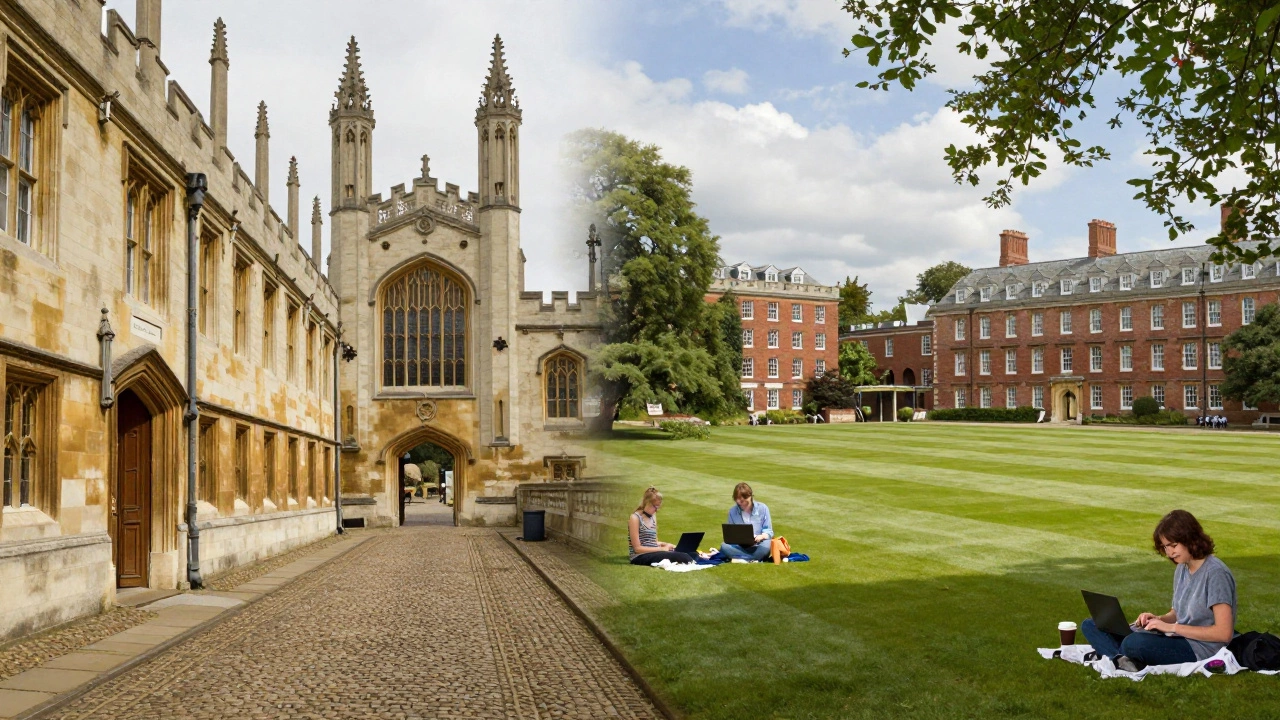
When we move to the university level, the gap becomes even clearer. University of Oxford and University of Cambridge (collectively Oxbridge) focus on the tutorial system. You meet with a professor one-on-one or in a tiny group to defend your essays. It's an intellectual boxing match. You are expected to have already mastered the basics because the UK system doesn't waste time on introductory courses.
The Ivy League schools in the US, like Harvard or Yale, offer a more "campus-centric" experience. There is a huge emphasis on extracurriculars, networking, and the "college experience." While academically rigorous, these universities encourage you to pivot. It's common for a student to start as a Pre-Med and graduate with a degree in Philosophy. The US university is a place to find yourself; the UK university is a place to refine yourself.
Which One Should You Choose?
It really comes down to your personality and your goals. If you're the type of person who loves a specific subject and wants to be an expert as quickly as possible, the UK system is your best bet. You'll avoid the boredom of mandatory classes you hate, and you'll enter the workforce or a PhD program faster.
On the other hand, if you're curious about a dozen different things and hate the idea of being "locked in" at 16, the US system is a paradise. It gives you the breathing room to fail, experiment, and change your mind. It's also generally more welcoming to students who struggle with high-stakes testing but excel in day-to-day application.
The Financial Reality Check
We can't talk about education without mentioning the bill. Generally, the UK is cheaper and faster. A three-year degree means one less year of tuition and one more year of earning a salary. While the UK has its own tuition fees, they are often more structured and predictable for domestic students.
The US is the most expensive place in the world to get an education. Between tuition, housing, and the "hidden costs" of campus life, the debt can be staggering. However, US graduates from top-tier schools often have access to a higher global starting salary, especially in fields like Finance or Tech, which can offset the initial cost. It's a high-risk, high-reward gamble.
Is a UK degree more respected than a US degree?
Neither is universally "more respected." It depends on the field. For theoretical sciences, history, and law, UK degrees (especially from Russell Group universities) are world-renowned for their depth. For business, entrepreneurship, and cutting-edge tech, US degrees from top universities often hold more sway due to the proximity to hubs like Silicon Valley and Wall Street.
Can I switch from the UK system to the US system?
Yes, it's very common. Many students take A-Levels and then apply to US colleges. US admissions officers generally value A-Levels highly because they demonstrate a level of specialization and academic rigor that the standard US high school diploma doesn't always show.
What is the biggest shock for a US student moving to the UK?
The lack of "hand-holding." US students are used to a lot of feedback and continuous assessment. In the UK, you might have very few assignments throughout the year, with your entire grade decided by a final exam in May or June. The independence required is much higher.
Does the US system make you a "jack of all trades, master of none"?
That's the common critique. While you might not have the same depth in a single subject as a UK student at 18, the US system builds critical thinking across disciplines. This often makes US graduates more adaptable in the workplace, as they can connect dots between different fields of study.
Which system is better for mental health?
It's a trade-off. The UK system has high-intensity peaks (exam season) that can be incredibly stressful. The US system has a constant, low-level hum of stress because every single assignment counts toward your GPA. Some people prefer the "get it over with" nature of UK exams, while others prefer the consistency of the US approach.
Next Steps for Students
If you're currently in the middle of GCSE revision and feeling the heat, remember that these exams are just the first gate. Whether you stay in the UK for A-Levels or look toward the US for a more flexible high school experience, the goal is to find an environment that matches how you learn. If you're feeling burned out by the exam-heavy culture, look into the International Baccalaureate (IB), which acts as a middle ground between the two systems.
For those leaning toward the US, start building a "portfolio." It's not just about grades; it's about what you do outside the classroom. For those staying in the UK, focus on mastering your core subjects. Depth is your greatest asset in the British system-don't be afraid to dive deeper than the syllabus requires.