
A Level UCAS Points Calculator
Your UCAS Points Result
Enter your A Level grades to see your points.
Typical University Requirements:
- University of Oxford A*AA
- University of Cambridge A*A*A
- Imperial College London A*A*A
- University of Edinburgh AAB
When you hear someone say they’re taking A Levels, you might wonder: A Level equivalent to what? It’s a question parents, students, and even teachers ask every year. If you’re trying to figure out if A Levels are the right path-or if they’re accepted overseas, or how they stack up against other qualifications-you’re not alone. Let’s cut through the confusion with real, practical answers.
What exactly are A Levels?
A Levels, short for Advanced Levels, are subject-based qualifications taken by students in England, Wales, and Northern Ireland after completing GCSEs. Most students take three or four subjects over two years, typically between ages 16 and 18. They’re not just exams-they’re in-depth courses that require critical thinking, independent study, and strong written analysis. Universities in the UK use A Level grades to decide who gets in. A grade of A* or A often means you’re competitive for top universities, while a C or above usually meets minimum entry requirements.
Each A Level subject is assessed through final exams, and some include coursework. Subjects range from core ones like Maths, English Literature, and Biology to niche options like Classical Civilisation, Psychology, or Film Studies. The grading scale runs from A* (highest) to E (lowest passing grade), with U meaning ungraded.
A Level equivalent: The most common comparisons
People often compare A Levels to other qualifications to understand their value. Here are the top three you’ll hear about:
- BTEC Level 3 Extended Diploma - This is a vocational alternative to A Levels. It’s coursework-based, not exam-heavy, and covers one broad subject area like Business, Engineering, or Health and Social Care. Many universities accept it, but some top universities prefer A Levels for academic subjects. A BTEC Extended Diploma is generally seen as equivalent to three A Levels.
- International Baccalaureate (IB) Diploma - The IB is a globally recognized program that requires students to study six subjects (including languages, sciences, and humanities), complete an extended essay, and take part in community service. It’s more well-rounded than A Levels. Most UK universities treat the IB Diploma as equivalent to three A Levels, with higher scores (38+ out of 45) often matching A*AA grades.
- Scottish Highers and Advanced Highers - In Scotland, students take Highers at age 16-17 and Advanced Highers at 17-18. One Advanced Higher is roughly equivalent to one A Level. Scottish universities often accept combinations of Highers and Advanced Highers in place of A Levels.
These aren’t perfect matches. A Levels let you specialize. The IB pushes you to be broad. BTECs focus on hands-on skills. So the "equivalent" depends on what you’re comparing them for.
Are A Levels accepted outside the UK?
Yes-widely. A Levels are recognized in over 100 countries, including the US, Canada, Australia, and the EU. But how they’re used varies:
- In the US - Colleges don’t use A Levels directly. Instead, they convert them into credit. For example, three A Levels at grades AAB might earn you 15-30 college credits (roughly one year of study). Some universities even offer advanced standing if you have high grades in relevant subjects.
- In Australia - Universities use an ATAR (Australian Tertiary Admission Rank) system. A Levels are converted into an ATAR score using a formula based on your grades. A*AA might give you an ATAR of 95+, which opens doors to top universities like Melbourne or Sydney.
- In Canada - Most provinces accept A Levels for university admission. Ontario, for instance, requires three A Levels, with grades often needing to be B or higher. Some universities also require specific subjects for certain programs.
The key takeaway? A Levels are portable. But you’ll need to check with each institution how they convert your grades.
How do A Levels compare to US high school diplomas?
This is a big one for families considering moving abroad or applying to US colleges. A US high school diploma is earned after 12 years of general education. It’s broad but shallow. A Levels, by contrast, are narrow but deep.
Think of it this way: A US student might take six subjects each year-Math, Science, English, History, PE, and Art. An A Level student takes three subjects intensely for two years. That’s why US universities often ask for SAT/ACT scores alongside A Levels. The SAT tests general readiness; A Levels prove subject mastery.
Many US colleges will accept A Levels in place of SAT Subject Tests (which were discontinued in 2021). If you have three A Levels with grades AAB or higher, you’re often seen as academically prepared for freshman year-even without an SAT score.
What about vocational routes? Are A Levels the only path?
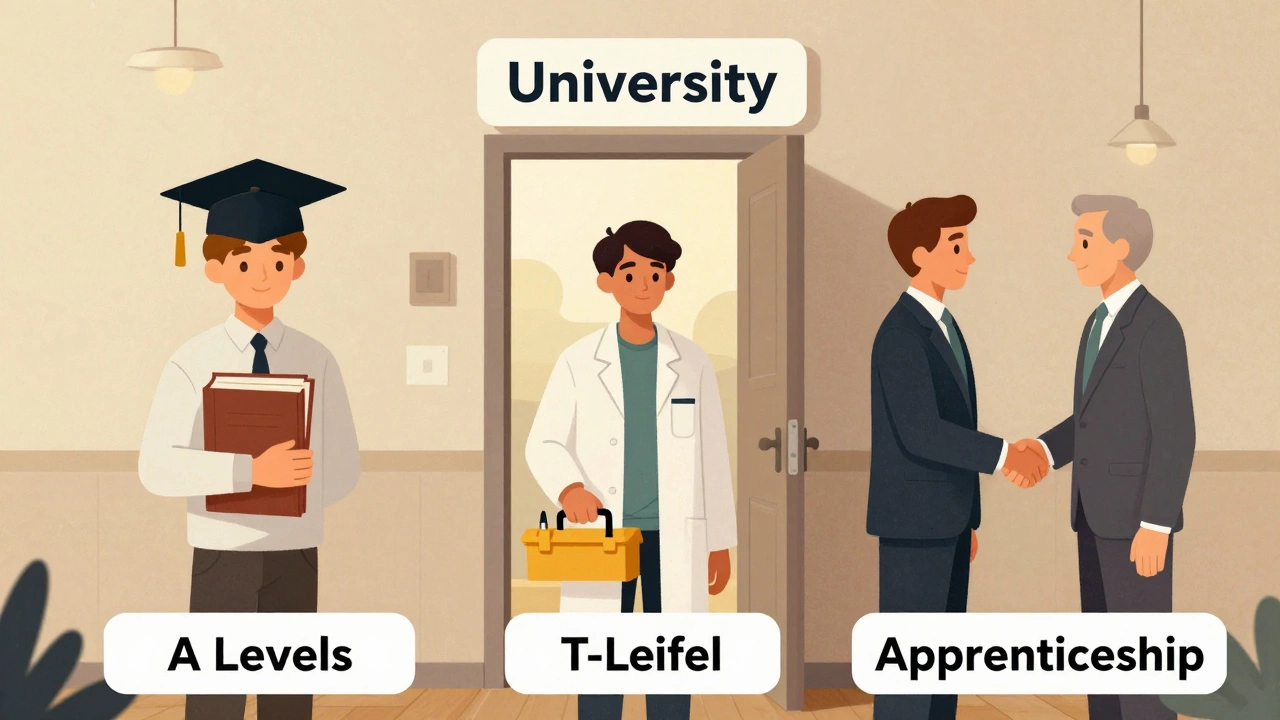
No. And this is where confusion creeps in. A Levels aren’t the only route to university, apprenticeships, or skilled jobs. Here’s what else exists:
- T-Levels - Launched in 2020, these are new technical qualifications designed to match industry needs. They combine classroom learning with a 45-day work placement. A T-Level is equivalent to three A Levels and is gaining rapid recognition from employers and universities.
- Apprenticeships - You can start a degree-level apprenticeship (Level 4-7) straight after GCSEs. These pay you to work while you study. Some lead to full bachelor’s or master’s degrees. They’re not "equivalent" to A Levels in the traditional sense-they’re a parallel pathway.
- Foundation Years - If your grades are below university entry requirements, some universities offer a one-year foundation course. It’s designed to bridge the gap between A Levels and degree-level study. Completing it successfully lets you enter Year 1 of a degree.
So while A Levels are the traditional route, they’re not the only one. Your path depends on your goals: academic research? A Levels. Hands-on career? T-Levels or apprenticeships.

What do universities really care about?
It’s not just about the qualification-it’s about the grades and the subjects. A university might say: "We need AAB in A Levels." But they also care whether those grades are in relevant subjects. For Medicine? You’ll need Chemistry and Biology. For Engineering? Maths and Physics. For Economics? Maths is essential.
Here’s a quick snapshot of what top UK universities look for:
| University | Typical Offer | Required Subjects |
|---|---|---|
| University of Oxford | A*AA | Subject-specific (e.g., Maths for Economics, Chemistry for Medicine) |
| University of Cambridge | A*A*A | Highly subject-specific; often requires Further Maths for Engineering |
| Imperial College London | A*A*A | Maths and Physics for Engineering; Chemistry for Medicine |
| University of Edinburgh | AAB | Varies by course; no universal requirement |
| University of Manchester | AAA | Depends on program; no specific subjects unless STEM |
Universities don’t just want high grades-they want grades in subjects that match their programs. A student with A* in Art and A in Drama won’t get into a Physics degree. Context matters.
Can you go to university without A Levels?
Absolutely. Many students enter university through:
- Access to Higher Education Diplomas - Designed for adults returning to education. Often completed in one year. Accepted by most UK universities.
- International qualifications - Like the IB, AP Exams (US), or the Canadian High School Diploma.
- Work experience - Some universities admit mature students based on professional experience, especially in fields like nursing, teaching, or social work.
The door isn’t closed if you don’t have A Levels. It’s just different.
Final thought: It’s not about equivalence-it’s about fit
Asking "What are A Levels equivalent to?" is like asking "Is a hammer equivalent to a screwdriver?" They’re both tools. But they’re used for different jobs.
A Levels are designed for students who want to go deep into academic subjects and aim for traditional university degrees. If that’s your path, they’re perfect. If you’re more hands-on, or want to start working sooner, BTECs, T-Levels, or apprenticeships might suit you better.
The best choice isn’t the one that matches someone else’s path. It’s the one that matches your goals, strengths, and interests. Don’t compare. Choose.
Are A Levels harder than BTECs?
It depends on what you’re good at. A Levels are exam-heavy and require strong written analysis. BTECs are coursework-based and focus on practical projects. If you struggle with exams but work well over time, BTECs might feel easier. If you thrive under pressure and enjoy deep subject study, A Levels could be a better fit. Neither is objectively harder-they’re just different.
Can I take A Levels as an adult?
Yes. Many adult learners take A Levels through further education colleges, online providers, or evening classes. Some even study part-time while working. There’s no age limit, and you can sit exams as a private candidate if needed. A Levels are open to anyone who meets the entry requirements for the course.
Do A Levels expire?
No, A Level grades don’t expire. Once you’ve passed, your results are valid for life. However, some universities or employers may ask for recent qualifications if your grades are more than five years old-especially in fast-changing fields like IT or healthcare. Always check with the institution you’re applying to.
How many UCAS points is an A Level worth?
Each A Level grade carries UCAS tariff points: A* = 56, A = 48, B = 40, C = 32, D = 24, E = 16. So three A Levels at AAB would give you 48 + 48 + 40 = 136 points. Most university courses require between 112 and 160 points. Note: T-Levels and BTECs also have UCAS points-so you can compare them directly.
Can I do A Levels and BTECs at the same time?
Yes, but it’s uncommon and demanding. Most colleges don’t encourage mixing them because they require very different study styles. However, some students take two A Levels and one BTEC to balance academic and practical subjects. It’s doable if you’re highly organized-but plan your workload carefully.