
Andragogy Self-Assessment Quiz
This interactive quiz helps you distinguish between child-focused learning (pedagogy) and adult-focused learning (andragogy). Select the answer that best aligns with andragogical principles.
Quiz Complete!
You scored 0 out of 0.
You quit school years ago. Maybe you went straight into a trade, or perhaps you burned out after university. Now, at 35, 45, or 60, you’re back in a classroom-physical or digital. But something feels different. The lectures feel dry, the memorization feels pointless, and the group projects feel like a chore. You aren’t lazy; you’re just trying to learn like a child when your brain is wired for efficiency.
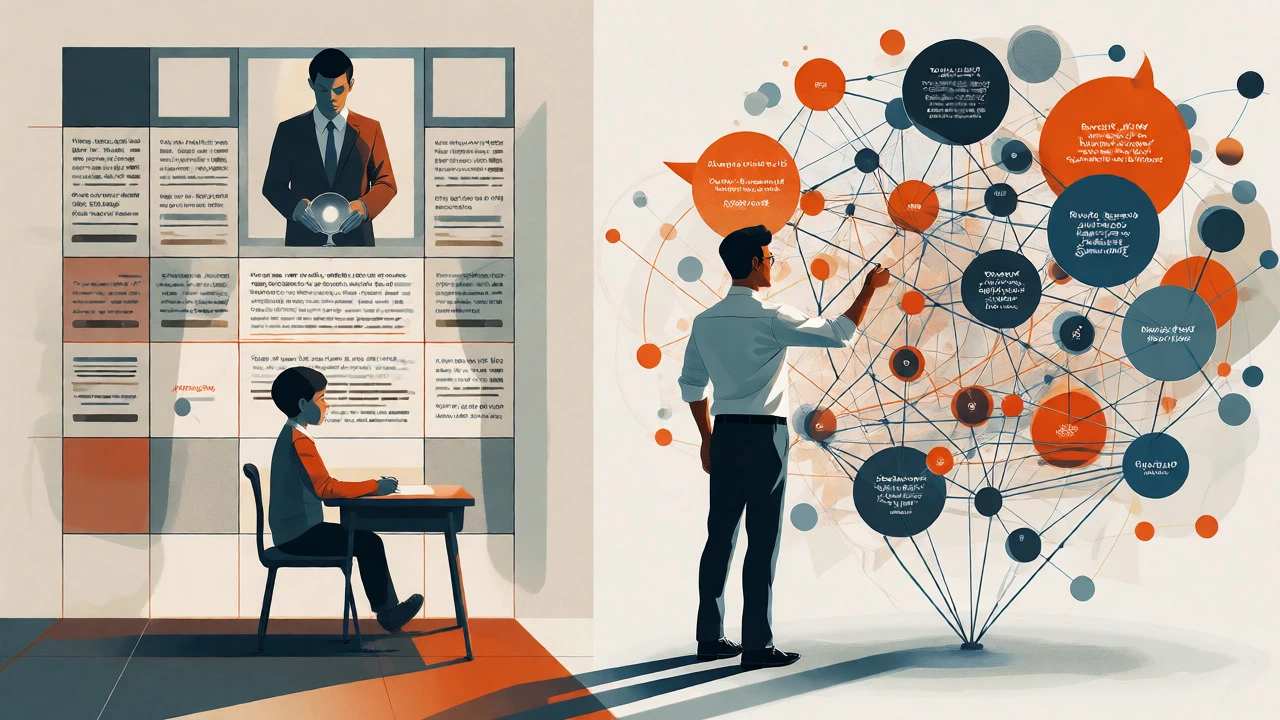
This friction happens because most educational systems are built for children. Andragogy, defined as the method and practice of teaching adult learners, assumes that adults are self-directed, experienced, and goal-oriented. Unlike pedagogy, which treats students as empty vessels to be filled, andragogy respects the learner’s prior knowledge. Understanding this concept isn’t just academic trivia-it’s the key to finally finishing that certification, mastering a new language, or pivoting your career without hating every minute of it.
The Shift from Pedagogy to Andragogy
Most people confuse adult learning with simply putting adults in a room with teachers. That’s not enough. Malcolm Knowles, the educator who popularized the term "andragogy" in the 1970s, identified five core assumptions that separate adult learners from children. If your current study method ignores these, you’re fighting against your own biology.
First, adults have a self-concept of being responsible for their own decisions. They resent being treated as dependent. Second, they accumulate a vast reservoir of experience. This experience becomes a resource for learning. Third, readiness to learn is tied to social roles. You don’t learn Excel because a teacher said so; you learn it because your new manager demanded a pivot table by Friday. Fourth, adults shift from subject-centered orientation to problem-centered orientation. They want to apply knowledge immediately. Fifth, internal motivators like self-esteem and quality of life drive them more than external grades.
| Attribute | Pedagogy (Child Learning) | Andragogy (Adult Learning) |
|---|---|---|
| Learner Self-Concept | Dependent personality | Self-directed, independent |
| Role of Experience | Limited; source of learning is the teacher | Extensive; rich resource for learning |
| Readiness to Learn | Biological maturation and curriculum schedule | Social roles and developmental tasks |
| Orientation to Learning | Subject-centered (future application) | Problem-centered (immediate application) |
| Motivation | External (grades, parental approval) | Internal (career advancement, satisfaction) |
Why Adults Forget What They Learn
You’ve probably experienced this: you attend a weekend workshop on leadership skills. It feels great in the moment. Two weeks later, you can’t remember three of the ten models presented. Why? Because traditional training often fails the "relevance test." For an adult, if information doesn’t solve a pressing problem right now, the brain discards it as noise.
Transformative Learning Theory, developed by Jack Mezirow, suggests that adult learning involves changing our frames of reference. We don’t just add facts; we critically reflect on our beliefs. When you try to force-feed abstract theory to an adult who hasn’t seen its practical use, you trigger resistance. The brain protects itself from cognitive overload by ignoring irrelevant data.
To fix this, stop asking "What do I need to know?" and start asking "What problem am I trying to solve?" If you are learning Python, don’t memorize syntax rules first. Write a script that automates a boring report you hate doing. The context anchors the memory. This approach leverages what psychologists call "situated learning," where knowledge is tied to the activity, context, and culture in which it was learned.
Self-Directed Learning: Taking Control
If andragogy has a heart, it’s Self-Directed Learning (SDL). SDL is a process in which individuals take the initiative, with or without the help of others, in diagnosing their learning needs, formulating learning goals, identifying human and material resources for learning, choosing and implementing appropriate learning strategies, and evaluating learning outcomes.
Many adults struggle with SDL not because they lack discipline, but because they lack structure. School taught us to wait for instructions. In the real world, no one hands you a syllabus. Here is a practical framework to master SDL:
- Diagnose Needs: Be honest about gaps. Don’t say "I want to learn marketing." Say "I need to understand SEO to increase my blog traffic by 20% in Q4."
- Set Goals: Make them specific. "Finish Module 3 of the Udemy course by Sunday" beats "Study more."
- Identify Resources: Curate your sources. Pick one book, one video series, and one community forum. Avoid analysis paralysis by limiting your inputs.
- Implement Strategies: Use active recall. Instead of re-reading notes, close the book and explain the concept to a rubber duck (or your cat). Teaching forces synthesis.
- Evaluate Outcomes: Did the traffic go up? If not, why? Adjust the strategy, not just the effort.
Notice how this loop mirrors professional project management. That’s no accident. Adults thrive when learning feels like work with clear deliverables, not homework with vague expectations.
The Role of Experience in New Skills
Your past jobs, failures, and hobbies aren’t baggage; they are scaffolding. When you learn something new, your brain tries to hook it onto existing neural pathways. This is why adults often learn faster than children in complex fields but slower in rote memorization.
For example, consider learning a second language. A child learns through immersion and mimicry, absorbing grammar subconsciously. An adult uses explicit grammar rules and analogies to their native tongue. If you speak French, learning Spanish is exponentially easier because you can map cognates and structures. Your experience provides a mental model.
However, experience can also hinder learning if it creates rigid habits. This is known as "negative transfer." If you’ve used Microsoft Word for twenty years, switching to Google Docs might frustrate you because you keep looking for the "Save As" button in the wrong place. To overcome this, acknowledge the old habit consciously. Say out loud, "In Word, I did X. In Docs, I will do Y." This metacognitive step breaks the autopilot mode.
Creating a Supportive Environment
Even the most motivated adult learner needs the right environment. Physical space matters, but psychological safety matters more. Adults fear looking incompetent. We hesitate to ask questions in meetings because we worry it makes us look stupid. This anxiety blocks retention.
To combat this, build a learning network. Find peers who are at a similar stage. Join a local meetup or an online Discord server related to your topic. Peer support normalizes the struggle. When you see someone else confused, your anxiety drops. Furthermore, teaching others reinforces your own understanding. The Feynman Technique suggests that if you can’t explain a concept simply, you don’t understand it well enough.
Also, manage your energy, not just your time. Adults rarely have four uninterrupted hours. We have fifteen minutes during lunch and thirty minutes after the kids sleep. Design micro-learning sessions. Break complex topics into bite-sized chunks. Use tools like Anki for spaced repetition, which algorithms optimize review times based on how likely you are to forget.

Overcoming Common Pitfalls
Let’s address the elephant in the room: procrastination. But for adults, procrastination is rarely laziness. It’s usually perfectionism or fear of failure. You delay starting because you’re afraid you won’t be good at it quickly. Or you’re afraid that investing time won’t yield immediate ROI.
Here are three traps to avoid:
- The Tutorial Hell: Watching endless YouTube tutorials without building anything. Action cures fear. Build something ugly. Then refine it.
- Imposter Syndrome: Feeling like a fraud because you’re older than your classmates or colleagues. Remember, you bring maturity and context they lack. You aren’t behind; you’re approaching from a different angle.
- All-or-Nothing Thinking: Believing that if you miss a day, you’ve failed. Consistency beats intensity. Studying 10 minutes daily is infinitely better than cramming 5 hours once a month.
Another pitfall is ignoring the biological reality of aging. Neuroplasticity-the brain’s ability to rewire itself-does slow down, but it never stops. Sleep hygiene becomes critical. During deep sleep, your brain consolidates memories. If you cut sleep to study, you’re sabotaging the very process you’re trying to enhance.
Practical Application: A Case Study
Meet Sarah, a 42-year-old accountant in Dublin. She wanted to transition into data analytics. Initially, she enrolled in a university-style evening course. She hated it. The professor lectured for two hours, then assigned textbook readings. Sarah felt disconnected and overwhelmed. She almost quit.
Then she applied andragogical principles. She stopped attending passive lectures. Instead, she downloaded a dataset from her previous job. She set a goal: "Create a dashboard showing quarterly expense trends using Tableau." She bought one specific guidebook and joined a Reddit community for Tableau beginners. She spent 30 minutes each morning experimenting with the software, consulting the guide only when stuck.
Within six weeks, she had a portfolio piece. More importantly, she enjoyed the process. Why? Because it was problem-centered, self-directed, and relevant to her career goals. She wasn’t learning "data analytics" in the abstract; she was solving a specific business problem she understood intimately.
Final Thoughts on Lifelong Learning
The concept of adult learning isn’t about finding a magic pill. It’s about respecting how your brain works now versus how it worked at eighteen. You are efficient, pragmatic, and experienced. Lean into those strengths. Stop trying to memorize everything. Start connecting new ideas to old ones. Focus on solving problems, not passing tests.
The world changes too fast for any degree to last forever. Embracing andragogy means accepting that learning is a continuous, self-managed journey. It’s less about filling a bucket and more about lighting a fire-one that burns steadily, fueled by curiosity and utility.
Is it harder to learn new things as an adult?
Not necessarily harder, just different. Children excel at implicit learning (absorbing languages naturally), while adults excel at explicit learning (using logic and patterns). Adults may need more time for rote memorization due to reduced neuroplasticity, but they often grasp complex conceptual frameworks faster due to accumulated experience and better metacognitive skills.
What is the difference between pedagogy and andragogy?
Pedagogy refers to the method of teaching children, characterized by teacher-led instruction and subject-centered curricula. Andragogy refers to the method of teaching adults, characterized by self-directed learning, problem-centered approaches, and the integration of the learner's prior experiences. While pedagogy assumes dependency, andragogy assumes independence.
How can I stay motivated to learn without deadlines?
Link learning to tangible rewards or immediate utility. Set micro-goals with short feedback loops. Join communities for accountability. Most importantly, focus on intrinsic motivation-learn because it solves a problem you care about or brings you joy, rather than for external validation. Visualizing the end result helps maintain momentum.
Do online courses work for adult learners?
Yes, if they align with andragogical principles. Look for platforms that offer self-paced modules, practical projects, and peer interaction. Passive video-only courses often have low completion rates for adults. Active learning platforms like Coursera, edX, or specialized bootcamps that require output-based assessments tend to be more effective for adult professionals.
What is transformative learning?
Transformative learning is a theory developed by Jack Mezirow that describes how adults change their perspectives through critical reflection. It involves questioning deeply held beliefs and assumptions, leading to a fundamental shift in worldview. This often occurs during "disorienting dilemmas"-crises or significant life changes that force a re-evaluation of one’s values and behaviors.