
Learning Disability Impact & Support Finder
Choose the profile that best matches your experience or interest.
The Invisible Struggle
Loading...
Strategies for Success
Why Context Matters
...
Select a Profile to Begin
Choose a learning disability from the menu to see specific challenges and evidence-based support strategies.
There is no single "hardest" learning disability. That’s the uncomfortable truth that frustrates parents, teachers, and students alike. If you’ve ever looked for a ranking of learning challenges, you probably found lists that pit dyslexia against ADHD or call dyscalculia the most severe. But human brains don’t work like video game difficulty settings. A condition that feels impossible to manage in a quiet classroom might be manageable in a hands-on workshop. Conversely, a mild struggle with reading can become a crisis when social expectations rise in high school.
The real answer depends on context: What skills does the person need to survive their daily life? How much support is available? And crucially, how invisible is the struggle? Often, the "hardest" disabilities are not the ones with the most obvious symptoms, but the ones that leave people confused, exhausted, and misunderstood by those around them.
Why is there no official ranking of learning disabilities?
Learning disabilities are neurodevelopmental variations, not diseases with linear severity scales. The impact depends on individual strengths, environmental demands, and co-occurring conditions. A child with strong verbal skills but poor math ability may thrive in humanities but fail in science, making the "difficulty" relative to their path.
The Invisible Struggle: Nonverbal Learning Disability (NVLD)
If we had to pick one profile that consistently reports feeling isolated and overwhelmed, it would be Nonverbal Learning Disability (NVLD), a pattern where visual-spatial reasoning and motor coordination lag significantly behind language skills. Unlike dyslexia, which has clear diagnostic markers in reading tests, NVLD often flies under the radar until adolescence. These individuals can speak eloquently, read fluently, and write complex essays. They sound smart. They act confident. But internally, they are navigating a world that makes no sense to them.
Imagine trying to read a room without understanding facial expressions. Imagine struggling to judge distances while walking down stairs or parking a car. For someone with NVLD, social cues are like a foreign language they never learned the grammar for. They might miss sarcasm, stand too close to others, or misinterpret tone. In school, this manifests as trouble with geometry, map reading, or organizing notes visually. The "hardness" here comes from the mismatch between intellectual capacity and functional execution. People assume they should know better because they are articulate. This leads to immense anxiety and depression, often diagnosed later than the learning difference itself.
Dysgraphia: When Your Hand Won’t Obey Your Brain
Dysgraphia is a specific learning disorder affecting written expression. It is frequently overlooked because it doesn’t always involve spelling errors. Some students with dysgraphia have perfect spelling but cannot form letters legibly. Others can write neatly but take three times longer than peers to complete an assignment. The physical act of writing causes pain, fatigue, and mental exhaustion.
Consider a teenager who knows exactly what they want to say. Their ideas are brilliant. But by the time they finish copying notes from the board, the teacher has moved on. By the time they finish a five-paragraph essay, their hand cramps, and their confidence shatters. In the digital age, typing mitigates some issues, but handwritten forms, signatures, and quick note-taking remain barriers. The emotional toll is significant because effort and output are disconnected. You can work harder than anyone else and still produce messy, slow results. This disconnect breeds shame and avoidance behaviors.
Complex Co-Occurring Conditions: The Perfect Storm
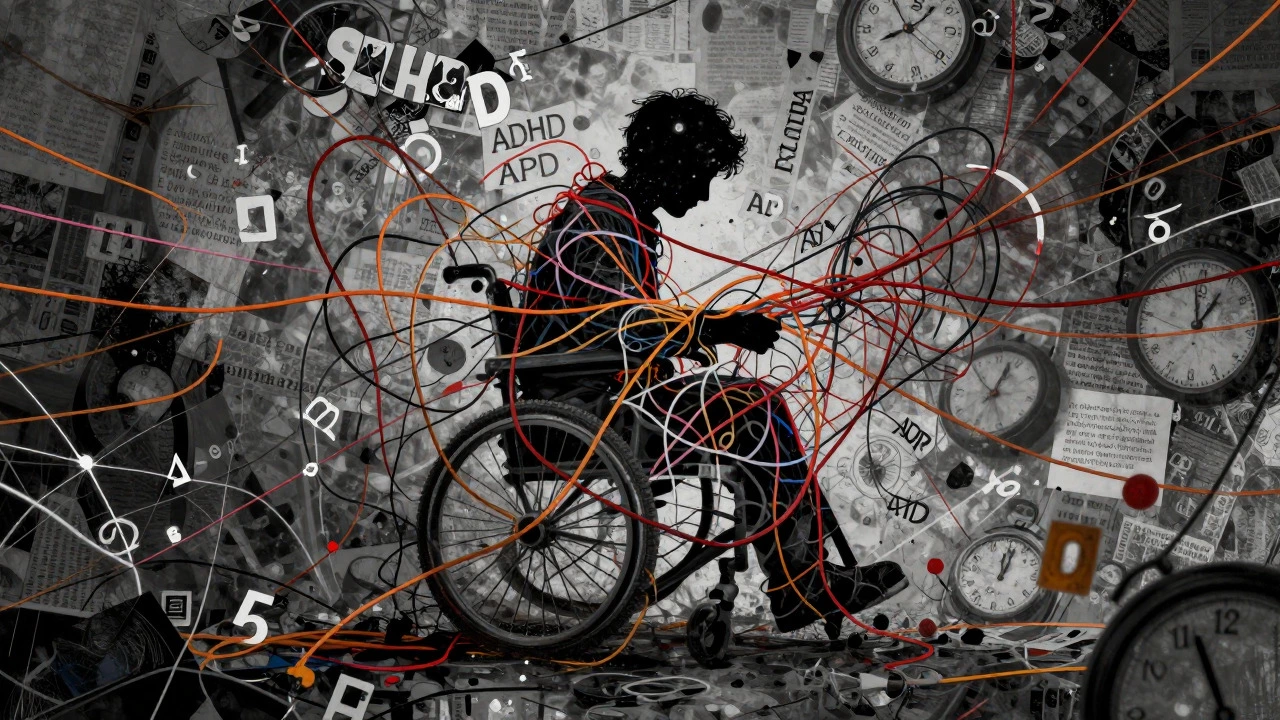
Rarely do learning disabilities exist in isolation. The most challenging scenarios arise when multiple conditions overlap. This is known as comorbidity. A student might have Dyslexia (reading), dyslexic disorder combined with ADHD (Attention Deficit Hyperactivity Disorder). Here, the brain struggles to decode text while simultaneously failing to sustain focus on the task. Add in Auditory Processing Disorder (APD), where the ear hears fine but the brain misinterprets sounds, and you have a student who cannot read, cannot listen effectively, and cannot stay still long enough to try again.
This combination creates a feedback loop of failure. The student tries to compensate for poor reading by listening more, but APD makes listening exhausting. They try to focus, but ADHD scatters their attention. Teachers may label them as "lazy" or "unmotivated" because the internal chaos isn’t visible. The "hardest" aspect here is the cumulative energy cost. Just getting through a standard eight-hour school day requires superhuman effort. Burnout is common, leading to school refusal or dropout rates higher than average.

Mathematics Anxiety and Dyscalculia
Dyscalculia is a specific learning disability that affects a person's ability to understand numbers and learn math facts. While dyslexia gets more media attention, dyscalculia can be equally debilitating in a society obsessed with quantitative data. It’s not just about being bad at arithmetic. It involves difficulty estimating time, managing money, understanding graphs, or even telling time on an analog clock.
The cultural stigma around math adds another layer of difficulty. We accept that some people are less artistic, but we rarely accept that some people are numerically impaired. Adults with untreated dyscalculia struggle with taxes, budgeting, and cooking measurements. Children face intense pressure in standardized testing environments. The abstract nature of advanced mathematics means there are fewer concrete tools to help. You can use flashcards for words, but how do you memorize the concept of algebraic variables if your brain doesn’t naturally grasp quantity relationships?
| Disability | Core Challenge | Hidden Impact | Common Misconception |
|---|---|---|---|
| Dyslexia | Decoding text and phonics | Reading fatigue, low self-esteem | Seeing letters backwards |
| NVLD | Social cues, spatial awareness | Anxiety, depression, isolation | They are socially awkward by choice |
| Dysgraphia | Written expression mechanics | Physical pain, incomplete assignments | Poor handwriting equals laziness |
| Dyscalculia | Number sense and calculation | Financial stress, time management issues | Just needs more practice |
The Role of Executive Function
Beneath many specific learning disabilities lies a broader issue: Executive Dysfunction. This refers to the brain’s management system-planning, prioritizing, initiating tasks, and regulating emotions. A student might have mild dyslexia but severe executive dysfunction. They can read slowly but accurately, yet they cannot organize their backpack, remember deadlines, or start homework without constant prompting.
In adulthood, this becomes critical. Job performance often hinges on organization and time management more than raw intelligence. An adult with strong technical skills but poor executive function may lose jobs due to missed deadlines or disorganized workflows. The "hardness" here is pervasive. It affects every area of life, from cleaning the house to maintaining relationships. Therapy and coaching are essential, but unlike tutoring for reading, there is no quick fix for rewiring executive processes.
Environmental Factors: Why Context Matters
A learning disability is only "hard" if the environment demands skills the person lacks. A dyslexic poet in a creative writing program may thrive. The same student in a law firm requiring rapid document review will struggle immensely. Therefore, the hardest disability is often the one least supported by the surrounding culture.
In Ireland, for example, the transition from primary to secondary school can be brutal for students with undiagnosed NVLD or ADHD. The shift from one main teacher to multiple subject specialists removes the safety net of consistent support. Students must advocate for themselves in new classrooms every hour. Without proper accommodations like extra time, note-takers, or sensory breaks, even moderate disabilities become insurmountable barriers. Early intervention changes everything. Waiting until age 14 to address foundational gaps leaves a student playing catch-up in a race they didn’t choose.
Strategies for Support and Success
Understanding that "hardest" is subjective allows us to focus on solutions rather than labels. Effective support looks different for each profile:
- For NVLD: Explicit instruction in social rules. Use scripts for conversations. Break down visual tasks into step-by-step checklists. Reduce ambiguity in instructions.
- For Dysgraphia: Allow typing over handwriting. Use speech-to-text software. Focus on content quality rather than neatness. Provide graphic organizers to structure thoughts before writing.
- For Comorbidities: Prioritize sleep and routine. Use external reminders (alarms, apps). Chunk large projects into tiny, manageable steps. Celebrate small wins to rebuild confidence.
- For Dyscalculia: Use real-world applications (cooking, shopping) to teach math. Visual aids and manipulatives are crucial. Avoid timed tests which increase anxiety and block recall.
Technology plays a huge role. Screen readers, AI-powered writing assistants, and calendar apps can level the playing field. However, technology is a tool, not a cure. The goal is independence, not dependency. Teaching a student *how* to use these tools and *when* to ask for help is part of the educational process.
Emotional Resilience and Mental Health
Perhaps the most underestimated factor is mental health. Years of struggling in school lead to chronic stress. Many adults with learning disabilities report histories of anxiety, depression, or PTSD related to educational trauma. The fear of failure can paralyze decision-making. Building resilience requires validating their experience. Telling a student "just try harder" ignores the neurological reality of their brain.
Therapy that incorporates Cognitive Behavioral Therapy (CBT) techniques can help reframe negative self-talk. Peer support groups are invaluable. Knowing you are not alone reduces the isolation. Parents and educators must model acceptance. When a child sees that their parent values their unique perspective despite their struggles, they begin to value themselves.
Conclusion: Reframing the Question
So, what is the hardest learning disability? It is the one that goes unrecognized. It is the one that silences a student’s voice. It is the one that forces a bright mind to hide its light because the format of assessment doesn’t fit. Instead of ranking disabilities, we should rank our systems’ flexibility. The best education system is one that adapts to the learner, not one that forces the learner to adapt to a rigid mold.
If you suspect a learning disability, seek a comprehensive evaluation from a qualified psychologist. Look beyond IQ scores. Assess processing speeds, memory, and executive function. Advocate for accommodations early. And remember, a learning disability is not a deficit of potential; it is a different pathway to achieving it.
Can a learning disability get worse over time?
The neurological basis of a learning disability remains stable, but its impact can worsen if demands exceed coping mechanisms. For example, a mild dyslexia may be manageable in elementary school but become crippling in university-level reading loads without support. Stress and lack of sleep can also exacerbate symptoms temporarily.
Is NVLD officially recognized in all countries?
No. NVLD is not currently listed as a distinct category in the DSM-5 (Diagnostic and Statistical Manual of Mental Disorders) used in the US, though it is widely recognized by psychologists. In Ireland and other parts of Europe, it may fall under Specific Learning Disorder or developmental coordination disorder depending on the presentation. Diagnosis often requires specialized neuropsychological testing.
How do I distinguish between ADHD and a learning disability?
ADHD is an attention regulation issue, while learning disabilities affect specific skill acquisition like reading or math. However, they often co-occur. If a student focuses well on interests but struggles across all subjects, it may be ADHD. If they focus fine but specifically struggle with decoding words despite good comprehension, it may be dyslexia. A professional evaluation is necessary to untangle these overlapping symptoms.
What accommodations are legally required in schools?
In Ireland, schools are required to provide reasonable accommodations under the Equality Act and Department of Education guidelines. This includes extra exam time, separate examination rooms, access to technology, and modified assessments. An Individual Educational Plan (IEP) outlines these supports. Parents should request formal documentation of these rights.
Can adults be diagnosed with learning disabilities?
Yes. Many adults receive diagnoses after years of unexplained struggles. Late diagnosis can be empowering, providing answers and access to workplace accommodations. Testing involves reviewing academic history, current cognitive assessments, and ruling out other factors like vision or hearing problems.