
A-Level vs AP Decision Simulator
Answer these questions to see which qualification system aligns best with your profile.
Your Recommended Path
Pros & Cons
- Pro: Deep expertise valued by UK unis.
- Pro: Fewer subjects = focused study.
- Con: Less breadth for US applications.
- Con: High stakes on single exam series.
Pros & Cons
- Pro: Shows versatility & rigor to US unis.
- Pro: Can earn college credit/placement.
- Con: Heavy workload if taking many courses.
- Con: Separate prep needed alongside GPA.
You’re sitting in a classroom in Dublin or London, staring at a syllabus that feels like it’s written in code. Then you hear about AP, which stands for Advanced Placement, a program run by the College Board in the United States. Suddenly, your brain does a backflip. Are they the same thing? Can you swap them? If you’re trying to figure out how to get into university, this question isn’t just academic curiosity-it’s a strategic decision that could change your entire application.
The short answer is no, they aren’t alike. But saying they are different is like saying apples and oranges are different because one is red and one is orange. It misses the point. They serve similar purposes-proving you can handle college-level work-but they go about it in completely different ways. One is a deep dive; the other is a broad survey. Understanding this distinction saves you from making a massive mistake when applying to universities abroad.
What Exactly Are A-Levels?
A-Levels, formally known as General Certificate of Education Advanced Level, are the gold standard for pre-university qualifications in the United Kingdom. They typically take two years to complete, usually during what we call Sixth Form or Year 12 and 13. The structure is rigid but focused. You don’t study ten subjects. You pick three or four. That’s it.
This narrow focus means you go incredibly deep. If you choose History, you aren’t just memorizing dates. You’re analyzing primary sources, writing essays that argue specific points, and understanding historiography. The assessment is mostly final exams at the end of the second year. There’s little coursework left in most subjects now, thanks to recent reforms. This makes A-Levels a test of endurance and depth. You need to know your subject inside out because there’s nowhere to hide if you only studied half the syllabus.
How Do AP Exams Work?
AP is quite different. It’s not a qualification you sit for after two years of dedicated study in the same way. Instead, AP courses are individual classes offered within the American high school curriculum. A student might take five AP classes in their senior year while still taking regular English and PE.
Each AP course ends with a standardized exam scored on a scale of 1 to 5. A score of 3 is often considered "passing," but competitive universities want 4s and 5s. Unlike A-Levels, where the exam defines your grade for that subject, AP scores are separate from your high school GPA. Your teacher gives you a letter grade (A, B, C) based on classwork, quizzes, and participation. The AP exam is an add-on. This dual system confuses many international students. You have to manage your daily class performance and prepare separately for the national exam.
Depth Versus Breadth: The Core Difference
Here is where the rubber meets the road. A-Levels specialize early. By age 16, you’ve already dropped subjects you don’t like. By 17, you’re studying only what you plan to do at university. This creates specialists. An A-Level Physics student has likely spent hundreds of hours solving complex mechanics problems. They might struggle with basic biology, but their physics knowledge is near first-year undergraduate level.
AP encourages breadth. American schools encourage students to take AP classes across disciplines. You might take AP Calculus BC, AP US History, and AP Psychology simultaneously. This shows versatility. Universities love well-rounded applicants who can handle math and humanities. However, the depth per subject is generally less than A-Levels. An AP Calculus AB course covers roughly half of what an A-Level Maths course covers. If you want to study engineering in the UK, an AP Calc AB score of 5 might not be enough without additional proof of mathematical rigor.
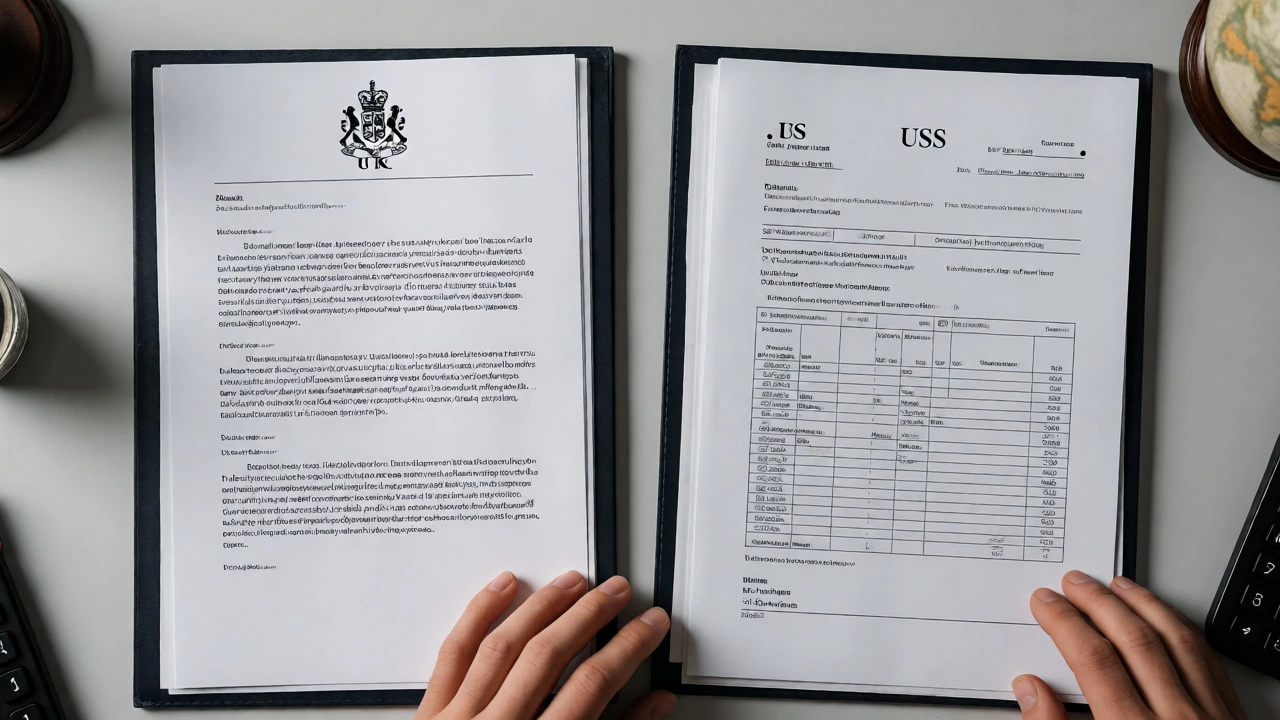
| Feature | A-Levels | AP Exams |
|---|---|---|
| Origin | United Kingdom | United States |
| Duration | 2 Years (Year 12 & 13) | 1 Year per course |
| Subject Load | 3-4 Subjects | Variable (often 3-8 courses) |
| Assessment Style | Final Exams (mostly) | Class Grades + Final Exam |
| Grading Scale | A* to E | 1 to 5 |
| University Credit | Rarely grants credit | Often grants credit/placement |

Which One Gets You Into University?
If you are applying to UK universities, A-Levels are the native currency. Admissions tutors understand them instantly. They know exactly what an 'A' in Chemistry means in terms of competence. They expect three A-Levels. If you show up with AP scores instead, you need to be careful. Top UK universities like Oxford, Cambridge, and Imperial College London accept AP, but they require high scores-usually 5s in relevant subjects-and often ask for SAT Subject Tests (now discontinued/replaced by APs in some contexts) or other evidence of specialization.
Conversely, if you’re eyeing US colleges, AP is king. American admissions officers look at your transcript. They want to see that you took the hardest classes available. Five AP courses with good grades looks impressive. They also use AP scores to grant college credit. If you get a 5 in AP English Literature, you might skip the freshman composition requirement. A-Levels are respected in the US, but they are viewed differently. Because A-Levels are so specialized, US admissions teams sometimes worry that the applicant lacks breadth. They might ask for SAT scores to gauge general reasoning skills.
The Cost and Accessibility Factor
Let’s talk money. In the UK, state schools offer A-Levels for free. Private schools charge fees, but the exam itself is part of the package. For private candidates, sitting A-Level exams costs around £50-£100 per subject. Not bad.
AP is pricier. Each exam costs roughly $98 USD (fees vary by country). If you take six AP exams, that’s nearly $600 before you even buy textbooks. Plus, not every school offers every AP course. In rural areas, access is limited. A-Levels are more standardized globally through exam boards like AQA, Edexcel, and OCR. AP is centralized by the College Board, which ensures consistency but limits flexibility. If your school doesn’t offer AP Computer Science, you can’t just sign up for it easily unless you find a private tutor or online provider.
Common Pitfalls to Avoid
Don’t assume an A in A-Level Math equals a 5 in AP Calculus BC. The content overlaps, but the testing style differs. A-Levels reward long-form explanation. AP rewards speed and multiple-choice precision combined with free-response questions. Practice past papers specifically for the format you are choosing.
Another trap is thinking you can mix and match freely. If you are in the UK doing A-Levels, adding an AP exam is possible but stressful. You are already juggling three intense subjects. Adding a fourth burden might lower your A-Level grades. Conversely, if you are in the US doing APs, switching to A-Levels mid-stream is rare because the curricula diverge significantly in Year 12.
Related Concepts Worth Knowing
To fully grasp these systems, you should also look at IB Diploma, which stands for International Baccalaureate Diploma Programme. The IB tries to combine the best of both worlds. It requires breadth (six subjects plus core components) and depth (Higher Level subjects). It is harder than AP in terms of workload but less specialized than A-Levels.
Also consider GCSEs, which stand for General Certificate of Secondary Education. These are the prerequisite for A-Levels in the UK. You cannot start A-Levels without passing GCSEs in relevant subjects. There is no direct equivalent in the US system, though middle school grades matter for high school placement.
Finally, keep an eye on SAT, which stands for Scholastic Assessment Test. While optional for many US colleges now, strong SAT scores can bolster an A-Level application by proving general aptitude alongside your specialized knowledge.
Can I convert my A-Level grades to AP scores?
No, there is no official conversion table. Universities evaluate them independently. An A* in A-Level Mathematics is generally considered equivalent to a top-tier AP Calculus BC score of 5, but admissions tutors look at the context of your entire application rather than a simple numerical swap.
Do US universities give credit for A-Levels?
Yes, many US universities grant credit for high A-Level grades (typically A or A*). However, policies vary widely by institution. Some may waive introductory courses, while others only count them toward elective credits. Always check the specific registrar’s policy for the university you are targeting.
Is AP harder than A-Level?
It depends on the metric. A-Levels are harder in terms of depth and independent study requirements over two years. AP is harder in terms of volume if you take many courses simultaneously. A single AP exam is generally shorter and faster-paced than an A-Level paper, but managing five APs alongside regular schoolwork is a significant logistical challenge.
Which is better for getting into medical school?
For UK medical schools, A-Levels in Chemistry and Biology are mandatory and highly preferred. For US medical schools, you need a bachelor’s degree first, so AP scores help you place out of pre-med prerequisites, speeding up your undergraduate timeline. Neither directly gets you into med school; they set the stage for the next step.
Can I take AP exams if I am not enrolled in an AP class?
Yes, you can self-study for AP exams. You register through a local school or testing center. However, you will not receive a class grade on your transcript, only the exam score. This is common for homeschooled students or those whose schools lack certain AP offerings.