
US University Subject Match Calculator
Subject Alignment Tool
This tool helps you identify which subjects are most valuable for your intended major at US universities based on your current curriculum (IB or A-levels).
Your Subject Recommendations
When you’re applying to US universities with A-levels or the International Baccalaureate (IB), you’re not just sending grades-you’re telling a story. And that story matters more than you think.
What US colleges actually look for
US universities don’t have a secret preference list for IB over A-levels-or the other way around. They don’t rank them like sports teams. Instead, they look at what your curriculum says about your academic habits. Are you pushing yourself? Are you learning deeply? Are you managing multiple demands at once? The University of California system, which accepts over 200,000 international applicants yearly, states clearly: "We evaluate applicants based on the opportunities available to them." That means if you took A-levels in a school that didn’t offer IB, they won’t penalize you. Same if you did IB and your school didn’t offer A-levels. What they care about is how you used what you had.How IB and A-levels differ in structure
IB is a full diploma program. You take six subjects: three at higher level (HL), three at standard level (SL). You also complete a 4,000-word extended essay, a theory of knowledge course, and 150 hours of creativity, activity, and service (CAS). It’s broad. It’s demanding. It’s designed to build well-rounded thinkers. A-levels are different. You typically take three or four subjects in depth. You might focus on Maths, Physics, and Chemistry if you’re aiming for engineering. Or History, English Literature, and Philosophy if you’re heading into humanities. There’s no mandatory essay, no service hours, no interdisciplinary course. You go deep, not wide. US admissions officers know this. They don’t expect IB students to be better because they did more. They expect A-level students to show mastery in their chosen fields.Why IB might seem more attractive
Some US colleges mention IB in their admissions brochures more often. That doesn’t mean they prefer it. It means IB is more familiar to them. Many US high schools offer IB. So admissions officers have seen thousands of IB transcripts. They understand the grading scale, the extended essay, the CAS requirement. They know what a 7 in HL Biology means. A-levels? Less common in US schools. So officers have to do more work to understand them. A grade of A* in A-level Chemistry? That’s excellent-but they might need to check conversion charts or ask your counselor for context. This isn’t bias. It’s familiarity. And familiarity can make things feel safer.What A-level students can do to level the playing field
If you’re applying with A-levels, don’t assume you’re at a disadvantage. You’re not. But you do need to help the admissions team understand your strengths. First, make sure your school sends a detailed transcript. Include subject descriptions. If you took Further Maths, say so. If your Physics class included a lab component that lasted 12 weeks, mention it. Don’t assume they know what A-levels cover. Second, use your personal statement to show depth. If you studied Economics and then started a student-run microloan project for local small businesses, that’s powerful. It shows you didn’t just learn theory-you applied it. Third, get a strong recommendation letter from your A-level teacher. A letter that says, "She was the only student in 10 years to score full marks on the Mechanics paper," carries more weight than generic praise.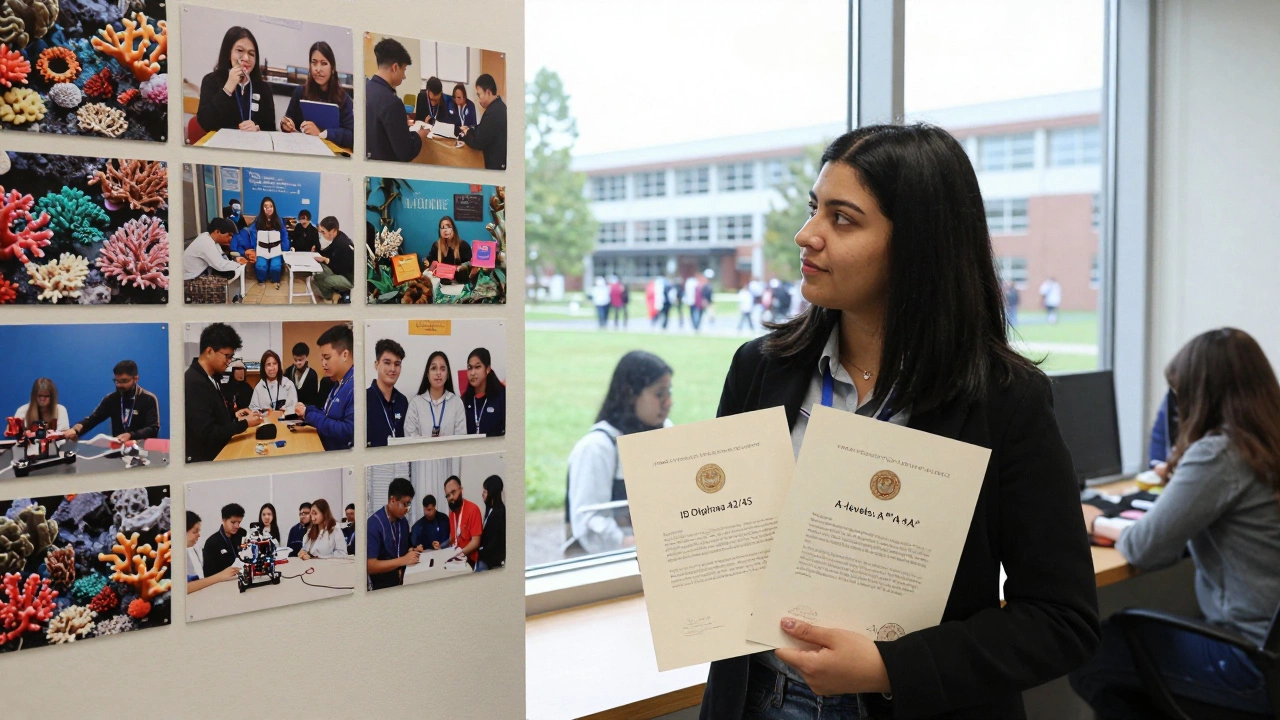
What IB students should avoid
IB students sometimes think doing everything means they’re automatically stronger. Not true. A student who took six subjects but barely passed three of them won’t impress anyone. A student who did well in IB but skipped CAS or wrote a rushed extended essay will raise red flags. US universities look for consistency. If you aced HL Maths but got a 4 in HL History, they’ll wonder why. Was it lack of interest? Poor time management? They’ll look for patterns. Also, don’t assume IB’s reputation will carry you. Harvard, Stanford, MIT-they admit IB students every year. But they also admit A-level students with perfect scores and extraordinary projects.Real examples from US admissions
A student from London applied to Stanford with A-levels in Maths, Further Maths, Physics, and Chemistry. All A*s. She also built a solar-powered water purifier for a village in Ghana during summer break. She got in. Another student from Madrid applied to Columbia with the full IB diploma. 42/45 points. HL in Biology, Chemistry, and English. She wrote her extended essay on coral reef restoration in the Caribbean. She got in. Both had strong academics. Both had real-world projects. Neither had an advantage because of their curriculum. Their outcomes were the same because their effort was.What subjects you take matters more than the system
US universities care about subject choices. If you want to study engineering, they want to see Maths and Physics. If you want to study psychology, they want to see Biology or Maths. An A-level student with three science subjects and an IB student with one science subject? The A-level student will look stronger for STEM. An IB student with HL in History, English, and Economics? That’s a great combo for social sciences. An A-level student with only two subjects? That’s a red flag. The system doesn’t decide your fate. Your subject choices do.
Bottom line: It’s not IB vs A-levels. It’s what you did with them.
US universities don’t prefer one over the other. They prefer students who challenge themselves, think critically, and follow through on ideas. If you took A-levels and focused on three subjects you’re passionate about-then went beyond the classroom to build, create, or lead-you’re just as competitive as any IB graduate. If you took IB but coasted through CAS or wrote your extended essay the night before deadline? You’ll be at a disadvantage. Your curriculum is just the stage. Your actions are the performance.What to do next
If you’re applying this year:- Make sure your school sends a full transcript with subject details and grading scales.
- Choose recommenders who can speak to your intellectual curiosity, not just your grades.
- Use your personal statement to show depth-not just achievement.
- Research each university’s international admissions page. Some list preferred subject combinations.
Do US universities accept A-levels?
Yes, US universities accept A-levels. They’re a standard qualification for international applicants. Most top universities, including Harvard, Stanford, MIT, and the University of Chicago, explicitly list A-levels as acceptable credentials. What matters is your grades, subject choices, and how you’ve used your time outside the classroom.
Is IB harder than A-levels?
IB is broader; A-levels are deeper. IB requires six subjects plus three core components (extended essay, theory of knowledge, CAS). A-levels typically focus on three or four subjects in depth. Neither is inherently harder-it depends on your strengths. If you thrive on variety and structure, IB might suit you. If you prefer to focus intensely on a few subjects, A-levels are a better fit.
Do US universities prefer HL subjects in IB?
Yes, but only in context. If you’re applying for engineering, HL Maths and HL Physics matter more than HL Art. Admissions officers look for subject alignment with your intended major. A high score in a relevant HL subject signals readiness. A high score in an unrelated subject doesn’t add much weight.
Can I apply to US universities with only 3 A-levels?
Yes. Three A-levels are standard and sufficient for US applications. Many students apply with three. What matters more is the rigor of those subjects and your overall profile. If your three A-levels are in Maths, Physics, and Chemistry-and you’ve led a robotics club or published a science blog-that’s stronger than four A-levels with weak grades or irrelevant subjects.
Do US universities convert IB and A-level grades to GPA?
They don’t convert them directly. Instead, they use their own internal benchmarks. For example, an A* in A-level Maths might be seen as equivalent to a 4.0 GPA in AP Calculus. An IB score of 7 in HL Biology might be viewed as similar to an A+ in a US college prep course. Admissions officers rely on experience, school profiles, and sometimes conversion guides-not automated formulas.