
GCSE Revision Strategy Planner
Select a review point or start a new topic to generate your schedule.
You’re staring at a textbook page that looks like it’s written in ancient Greek. It’s two months before your GCSE exams, and you’ve read the same paragraph on photosynthesis four times. You remember nothing. Sound familiar? Most students think revision means re-reading notes or highlighting textbooks until the pages glow yellow. But here’s the hard truth: passive reading is one of the least effective ways to learn. If you want to actually retain information and walk into that exam hall with confidence, you need a strategy that works with your brain, not against it.
Why Your Current Revision Method Might Be Failing You
Let’s be honest. Re-reading your class notes feels productive because it’s easy. Your brain recognizes the words, so you assume you know them. This is called the "illusion of competence." You mistake familiarity for knowledge. When you sit down in the exam, under pressure, without your notes, that recognition vanishes. You can’t retrieve the information because you never practiced retrieving it; you only practiced recognizing it.
To fix this, we need to shift from passive consumption to active engagement. The most robust evidence in cognitive science points to two specific techniques: active recall and spaced repetition. These aren't just buzzwords; they are methods proven to strengthen neural pathways and move information from short-term memory to long-term storage.
The Power of Active Recall
Active recall is the process of testing yourself instead of just reviewing material. Think of your memory like a muscle. Every time you struggle to pull an answer out of your head, you’re doing a rep. The harder the retrieval, the stronger the connection becomes. This is known as the "testing effect." So, how do you actually do this? Stop opening your textbook. Close it. Take a blank sheet of paper and write down everything you remember about a topic. Then, open your book and check what you missed. Write the missing bits in a different color. Do this again the next day. You’ll be shocked by how much you forget after just 24 hours if you don’t actively test yourself.
- Flashcards: Use apps like Anki or Quizlet, but make sure you create the cards yourself. The act of making the question forces you to identify key concepts.
- Blurting: As mentioned, write everything you know on a blank page, then correct it.
- Teach It: Explain a complex concept to a friend, a parent, or even your dog. If you stumble, you’ve found a gap in your knowledge.
Spaced Repetition: Beating the Forgetting Curve
Your brain is designed to forget things. It’s a survival mechanism to clear out irrelevant data. In 1885, psychologist Hermann Ebbinghaus mapped this decline, creating the "Forgetting Curve." He showed that we lose about 70% of new information within 24 hours if we don’t review it. Spaced repetition fights this curve by scheduling reviews at increasing intervals. Instead of cramming five hours of history on Monday and ignoring it until Friday, try this schedule:
- Review the material immediately after learning it.
- Review it again after one day.
- Review it after three days.
- Review it after one week.
- Review it after one month.

Interleaving: Mixing Up Your Subjects
Most students block-study. They spend three hours on Maths, then three hours on English. While this feels organized, it can lead to superficial learning. Interleaving involves mixing different topics or types of problems within a single study session. For example, if you’re revising Maths, don’t just do twenty quadratic equations in a row. Mix them with geometry problems and algebraic fractions. Why? Because in the real world (and in exams), you don’t get told which formula to use. You have to decide which tool fits the problem. Interleaving trains your brain to discriminate between concepts and select the right strategy, rather than just mechanically applying the last one you learned.
Past Papers Are Non-Negotiable
If there is one thing you must do, it’s past papers. Not just reading them-doing them. Under timed conditions. No notes. No phone. This serves three purposes:
- Familiarity: You learn the style of questions asked by exam boards like AQA, Edexcel, or OCR.
- Application: You practice applying your knowledge to specific scenarios.
- Mark Scheme Analysis: This is the secret weapon. After marking your paper, look closely at the mark scheme. Notice exactly what earns marks. Often, students lose points for missing specific keywords or steps. Understanding the examiner’s expectations is half the battle.
Managing Stress and Sleep
Revision isn’t just about what you put in; it’s about how your brain processes it. Sleep is critical. During deep sleep, your brain consolidates memories, moving them from the hippocampus (short-term) to the neocortex (long-term). Pulling all-nighters actually hinders this process. You might feel like you’re getting more done, but you’re retaining less. Stress management matters too. High cortisol levels impair memory retrieval. If you’re panicking, take a break. Go for a walk. Breathe. A calm mind retrieves information faster than a frantic one. Remember, GCSEs are important, but they don’t define your entire future. Keeping perspective helps you perform better.
A Practical Weekly Schedule
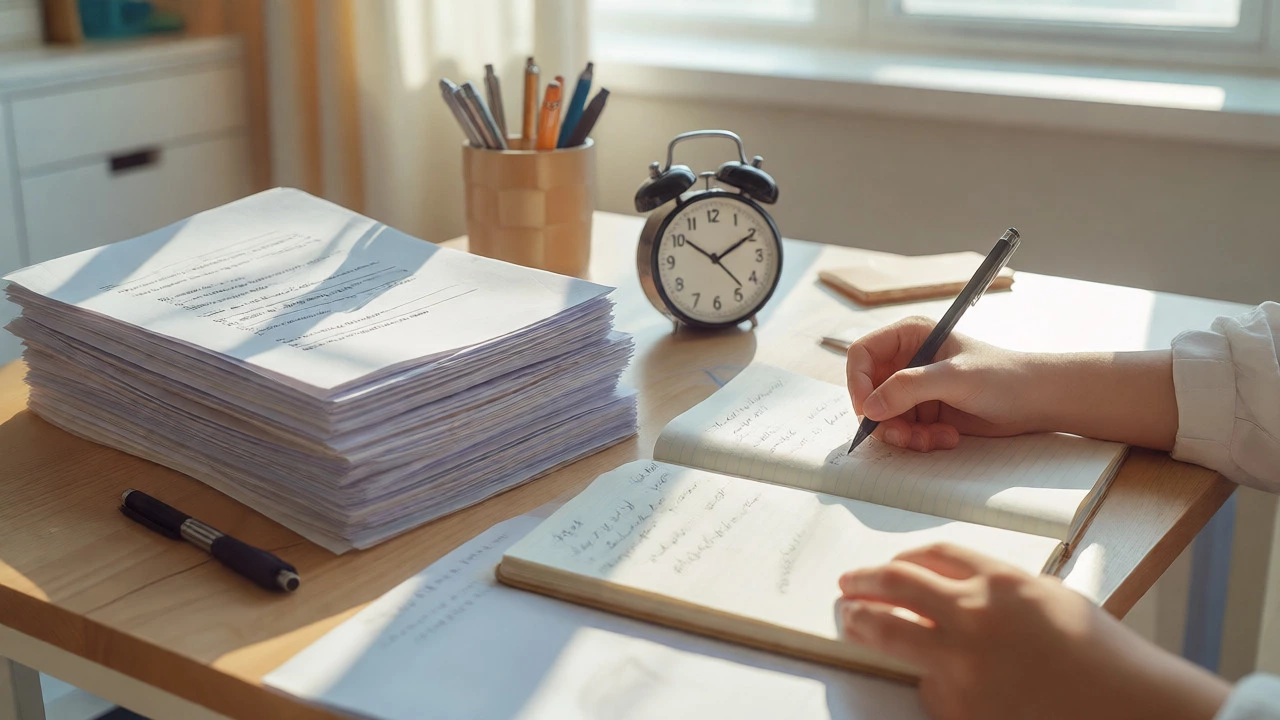
How do you fit all this into a busy life? Here’s a realistic template for a student balancing school and homework.
| Day | Focus Area | Technique | Duration |
|---|---|---|---|
| Monday | Maths (Algebra) | Active Recall + Practice Problems | 45 mins |
| Tuesday | English Literature | Blurting Quotes & Themes | 30 mins |
| Wednesday | Science (Biology) | Spaced Repetition Flashcards | 30 mins |
| Thursday | History | Interleaved Topic Review | 45 mins |
| Friday | Full Past Paper | Timed Simulation | 1 hr 30 mins |
| Saturday | Weak Areas | Targeted Revision based on Friday's errors | 1 hr |
| Sunday | Rest / Light Review | No heavy lifting. Mental reset. | - |
This plan uses short, focused bursts rather than marathon sessions. Consistency beats intensity every time. Thirty minutes of focused, active revision daily is far superior to five hours of distracted reading once a week.
Common Pitfalls to Avoid
Even with good intentions, students fall into traps. Watch out for these:
- Highlighting Everything: If the whole page is highlighted, nothing is important. Highlight sparingly, only key terms or definitions you keep forgetting.
- Making Pretty Notes: Spending an hour choosing the right colored pens is procrastination. Messy notes that help you recall information are better than beautiful notes you never look at again.
- Ignoring Weak Subjects: We tend to revise subjects we enjoy or are good at because it feels nice. Force yourself to tackle the hardest subject first when your energy is highest.
- Studying Alone Too Much: Group study can be great for explaining concepts to each other, but avoid groups where everyone just chats. Keep groups small and task-focused.
Final Thoughts on Exam Day
By the time you reach exam season, your goal isn’t to learn new content. It’s to maintain what you’ve built. Trust the process. You’ve done the active recall, you’ve spaced your repetitions, and you’ve analyzed your mistakes. Now, go get some sleep, eat a proper breakfast, and trust your preparation. The work is done; now it’s just about execution.
How many hours a day should I revise for GCSEs?
Quality matters more than quantity. For most students, 1-2 hours of focused revision per day during term time is sufficient, increasing to 3-4 hours during Easter breaks or holidays. Using techniques like the Pomodoro method (25 minutes of work, 5 minutes of break) helps maintain focus and prevents burnout.
Is it better to revise alone or in a group?
A mix is ideal. Study alone for active recall and memorization tasks, as distractions hinder deep focus. Use group study for discussing complex concepts, teaching each other, or practicing essay plans. However, ensure the group stays on task; otherwise, it becomes socializing.
What is the best app for GCSE revision?
Anki is highly recommended for its powerful spaced repetition algorithm. Quizlet is user-friendly and great for pre-made decks. For subject-specific content, BBC Bitesize and Seneca Learning offer interactive quizzes aligned with UK curricula. Choose one or two tools and stick to them to avoid switching costs.
Should I start revising in Year 9?
Yes, light revision in Year 9 is beneficial. Focus on understanding core concepts rather than rote memorization. Creating basic flashcards or summary sheets for key topics as you learn them saves massive amounts of stress in Year 10 and 11. Early exposure reduces the volume of new information later.
How do I handle a bad mock exam result?
Don’t panic. Mocks are diagnostic tools, not final judgments. Analyze the feedback carefully. Identify whether errors were due to lack of knowledge, misunderstanding the question, or poor time management. Adjust your revision strategy accordingly. A bad mock tells you exactly where to focus your remaining effort.