
Spaced Repetition Review Planner
Step 1: Set Your Study Date
Enter the date you first learned or read the material (The 'Read' phase).
Ready to Plan?
Enter a date to see how the 1-3-7 rule spaces out your reviews for maximum retention.
Your Spaced Repetition Timeline
Based on 1-3-7 RuleRetention Strength over time if you stick to this schedule:
You’ve sat at your desk for hours. You’ve highlighted every other sentence in your textbook. You feel like you know the material inside out. Then you walk into the exam room, read the first question, and realize you can’t remember a single thing. This is the classic "illusion of competence." It happens because reading notes over and over feels like learning, but it isn't.
Real retention requires a different approach. In the world of cognitive science and effective studying, there is a framework often referred to as the three R's of memorization: Read (or Receive), Recall, and Review. These aren't just catchy words; they are the mechanical steps your brain needs to move information from short-term working memory into long-term storage. If you skip one, the chain breaks.
1. Read (Receive): Encoding Information Correctly
The first R stands for Read, but in modern learning theory, we often call this "Receive" or "Encode." This is the input phase. Most students think this means highlighting text or re-reading chapters until their eyes glaze over. That’s passive. Passive reading has a low retention rate-often less than 10% after a week.
To make the first R work, you need active encoding. When you read a new concept, you must understand it before you try to memorize it. Your brain cannot store what it doesn't process. Think of it like trying to save a file on a computer with a corrupted format. It won't open later.
Here is how to do the first R right:
- Summarize in plain English: After reading a paragraph, look away and say what it means in simple terms. If you can't explain it simply, you didn't read it deeply enough.
- Connect to existing knowledge: Link the new fact to something you already know. If you're studying biology, compare cell structures to parts of a city. This creates neural hooks.
- Avoid multitasking: Put the phone in another room. Cognitive load theory shows that splitting attention reduces encoding efficiency by up to 40%.
This step sets the foundation. Without clear encoding, the next steps will fail because you’re trying to retrieve noise instead of signal.
2. Recall: The Power of Active Retrieval
This is where most study sessions go wrong. The second R is Recall. This is also known as "Active Retrieval" or the "Testing Effect." Instead of looking at your notes again, you close them and try to pull the information out of your head.
Why does this hurt? Because struggling to remember strengthens the neural pathway. Every time you successfully recall a fact without looking, you reinforce the connection. It’s like lifting weights. If someone else lifts the weight for you (re-reading notes), your muscles don't grow. If you lift it yourself (recalling), they do.
Research from the University of California, Berkeley, and other institutions consistently shows that students who use retrieval practice score significantly higher on exams than those who only re-read. Here is how to implement Recall:
- The Blank Page Method: Take a sheet of paper. Write down everything you remember about a topic. Then check your notes to see what you missed. Focus your next study session only on the gaps.
- Flashcards done right: Don't just flip the card. Say the answer out loud before flipping. If you hesitate, mark that card as "weak" and review it sooner.
- Self-quizzing: Turn headings into questions. Instead of reading "Causes of World War I," ask yourself "What were the four main causes of WWI?" and answer it.
Recall is uncomfortable. It feels slow. But it is the single most effective technique for long-term retention. If your study session feels easy, you are probably not recalling enough.

3. Review: Spaced Repetition Beats Cramming
The third R is Review. But not random review. Not reviewing everything every day. This R relies on the concept of "Spaced Repetition." Human memory follows a "forgetting curve," discovered by Hermann Ebbinghaus in 1885. We forget about 50% of new information within an hour if we don't review it.
Spaced repetition involves reviewing material at increasing intervals. You review something one day after learning it, then three days later, then a week later, then a month later. Each time you review, the interval gets longer because the memory becomes stronger.
Why does spacing work? Because each time you are about to forget, you pull the memory back. This "desirable difficulty" signals to your brain that this information is important and needs to be stored permanently. Cramming puts information into short-term memory, which evaporates quickly. Spacing builds long-term infrastructure.
How to structure your Reviews:
- Use a system: Apps like Anki or Quizlet use algorithms to schedule reviews for you. They show you cards just before you are likely to forget them.
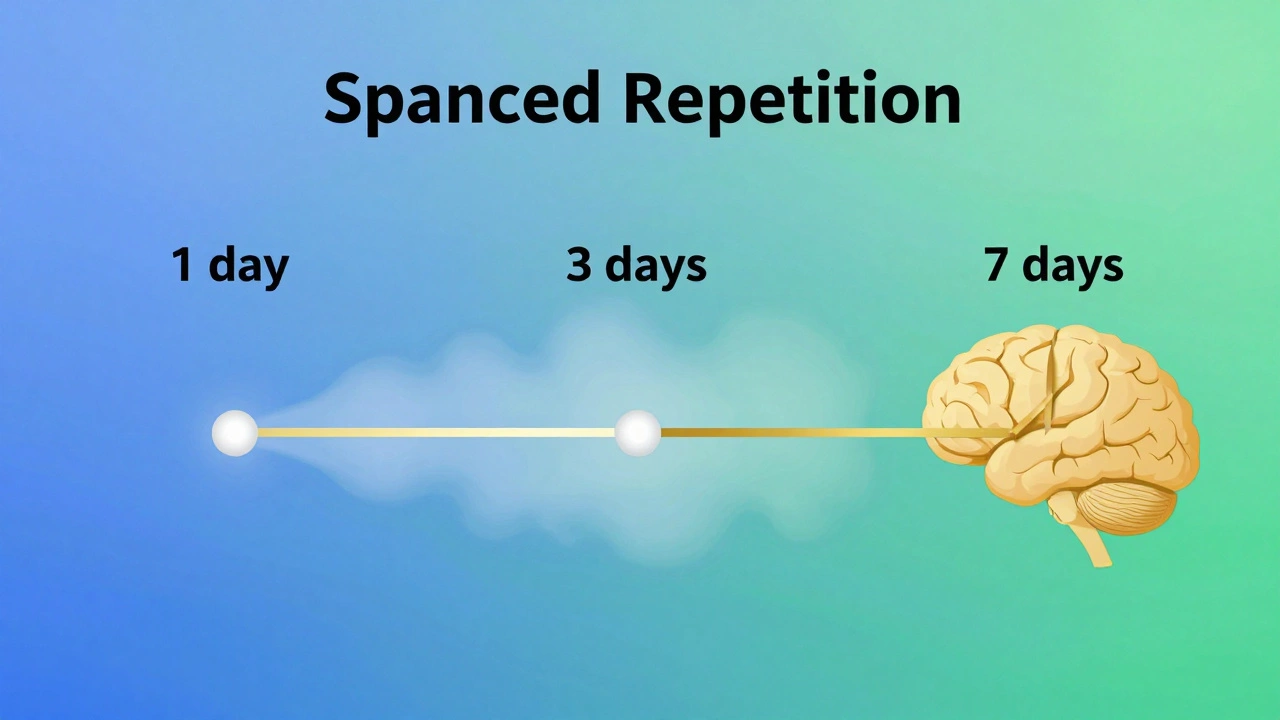
- The 1-3-7 Rule: If you don't use an app, follow this pattern. Review new material 1 day after learning, then 3 days later, then 7 days later.
- Mix it up: Interleave topics. Don't study only math for three hours. Mix math, history, and science. This forces your brain to constantly switch contexts, improving discrimination between concepts.
Review is not about perfection. It’s about consistency. A five-minute review session daily is far more powerful than a five-hour marathon once a month.
Putting the Three R's Together: A Practical Workflow
Knowing the theory is one thing. Applying it to your actual exam prep is another. Let’s look at how a student named Sarah prepares for her History A-Level exam using the Three R's.
Step 1: Read (Encoding)
Sarah reads a chapter on the French Revolution. She doesn't highlight. Instead, she writes a one-paragraph summary in her own words. She draws a quick timeline connecting key events to people she already knows.
Step 2: Recall (Retrieval)
An hour later, Sarah closes the book. She takes a blank piece of paper and tries to reconstruct the timeline and summarize the causes of the revolution. She struggles with the economic factors. She marks this as a weak point.
Step 3: Review (Spacing)
The next day, Sarah spends ten minutes reviewing only the economic factors she struggled with. She uses flashcards for specific dates and treaties. Three days later, she reviews the entire chapter again, mixing it with a review of the Industrial Revolution to interleave topics.
This workflow takes less total time than traditional cramming but results in much deeper understanding and retention. Sarah isn't just memorizing facts; she is building a mental model.
| Method | Effort Level | Retention Rate | Best For |
|---|---|---|---|
| Re-reading Notes | Low | Poor (<10%) | Familiarity, not mastery |
| Highlighting | Low | Poor | Identifying key sections |
| Active Recall | High | Excellent (>70%) | Long-term memory |
| Spaced Review | Medium | Very Good | Preventing forgetting |
Common Pitfalls to Avoid
Even with the best intentions, students fall into traps. Here are the most common mistakes when applying the Three R's:
- Skipping the struggle: If you find the answer immediately, you haven't recalled it. You recognized it. There is a big difference. Force yourself to wait five seconds before checking the answer.
- Overloading the first Read: Trying to memorize too much in one sitting leads to cognitive overload. Break material into small chunks (chunking). Study for 25 minutes, break for 5 (Pomodoro Technique).
- Inconsistent Review: Doing all your reviewing the night before the exam is useless. Spacing requires time. Start early. Even 15 minutes a day is better than zero.
Another mistake is treating all subjects the same. Math requires problem-solving recall, while History requires narrative recall. Adjust your methods accordingly. For math, recall the steps to solve a problem type. For History, recall the sequence of events.
Tools to Support the Three R's
You don't need expensive software to use these techniques. However, certain tools make the process smoother.
Anki: A free, open-source flashcard app that uses spaced repetition algorithms. It’s powerful but has a learning curve. Great for medical students or language learners.
Quizlet: More user-friendly than Anki. Good for basic flashcards and games. Less robust for long-term scheduling unless you pay for premium features.
Pen and Paper: Never underestimate the power of writing. Writing by hand engages motor memory and helps with encoding. Use blank sheets for recall exercises.
Teaching Others: The Feynman Technique is a form of recall. Try to teach a concept to a friend or even an imaginary audience. If you get stuck, you’ve identified a gap in your knowledge.
What are the three R's of memorization?
The three R's of memorization are Read (Encode), Recall (Retrieve), and Review (Space). Read involves actively understanding and processing new information. Recall involves testing yourself to pull information from memory without looking. Review involves revisiting the material at increasing intervals to strengthen long-term retention.
Is reading notes considered memorization?
No, reading notes is passive recognition, not active memorization. While it helps you become familiar with the material, it does not strengthen the neural pathways needed for recall during an exam. Active recall is required for true memorization.
How often should I review material?
You should review material using spaced repetition. A good starting point is the 1-3-7 rule: review one day after learning, then three days later, then seven days later. As the memory becomes stronger, you can extend the intervals to weeks or months.
Why is active recall better than re-reading?
Active recall forces your brain to work hard to retrieve information, which strengthens the memory trace. Re-reading is passive and creates an illusion of competence. Studies show that retrieval practice leads to significantly higher test scores than repeated reading.
Can I use the three R's for any subject?
Yes, the three R's apply to all subjects. For factual subjects like history or biology, focus on recall of dates and definitions. For procedural subjects like math or coding, focus on recalling the steps to solve problems. Adapt the method to fit the content type.
What is the forgetting curve?
The forgetting curve, described by Hermann Ebbinghaus, illustrates how information is lost over time when there is no attempt to retain it. We forget most new information quickly unless we review it. Spaced repetition counters this curve by reinforcing memories just before they fade.
How long should each study session be?
Short, focused sessions are best. The Pomodoro Technique suggests 25 minutes of study followed by a 5-minute break. This prevents cognitive fatigue and keeps your brain fresh for active recall tasks. Longer sessions often lead to diminishing returns.