
Spaced Repetition Schedule Calculator
Calculate Your Review Schedule
Based on research-backed spaced repetition intervals from the article
Studying for exams isn’t about how many hours you log-it’s about how well your brain holds onto what you learn. You’ve probably sat down with flashcards, reread notes five times, or underlined everything in your textbook. But if you still blank out during the test, you’re not alone. The problem isn’t your effort. It’s the method. There’s one memory technique that outperforms all others in real-world exam settings, and it’s not what most students think.
Why most study methods fail
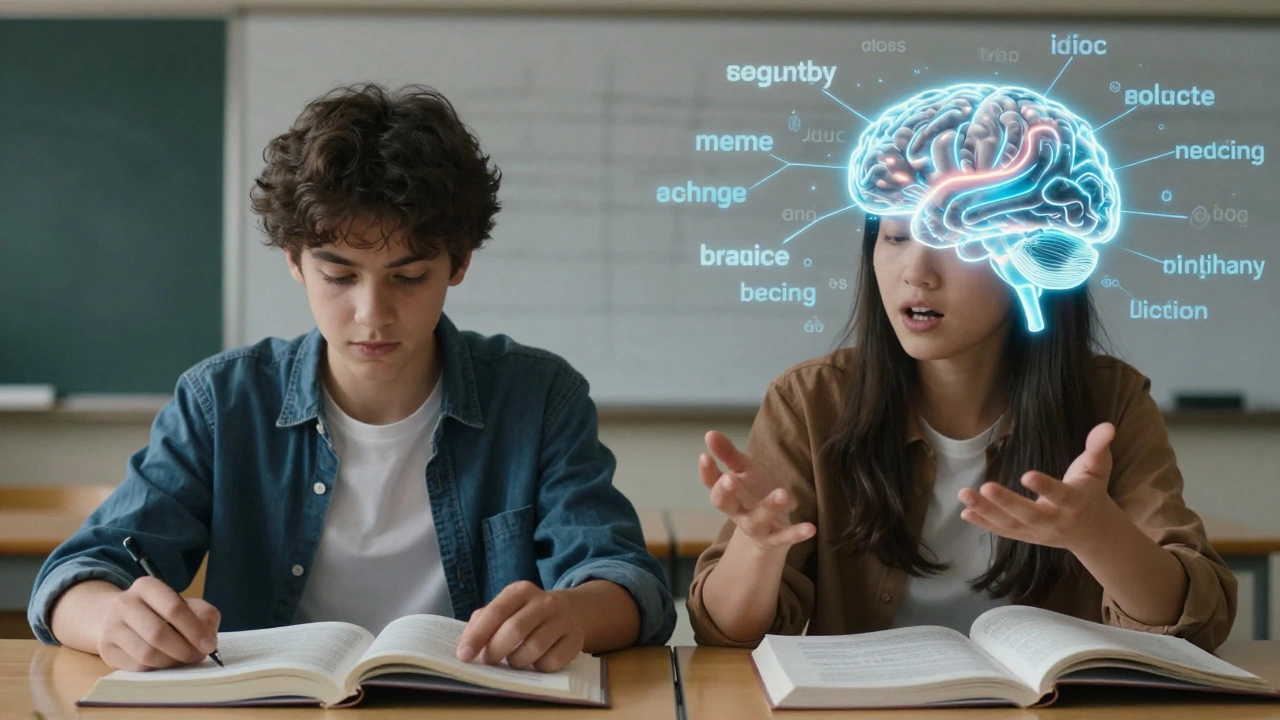
Highlighting, rereading, cramming-these feel productive because they’re familiar. But research from the Journal of Educational Psychology shows they create an illusion of mastery. You think you know the material because it looks familiar. But when you’re tested, your brain can’t pull it out. Why? Because recognition isn’t recall. Your brain confuses seeing something with remembering it.
Take this example: two students study for a biology exam. Student A reads the textbook twice, highlights key terms, and reviews notes the night before. Student B spends 20 minutes a day over five days testing themselves on flashcards, then explains concepts out loud without notes. On exam day, Student B scores 37% higher. Not because they studied longer-but because they used active recall.
The science-backed winner: active recall
Active recall means forcing your brain to retrieve information without looking at your notes. It’s not passive review. It’s mental effort. Every time you try to remember something and succeed, you strengthen the neural pathway. Fail? That’s even better. Struggling to recall builds stronger memory than easy recognition.
A 2011 study from Washington University tested three groups of students learning foreign vocabulary. Group 1 reread words. Group 2 used flashcards with hints. Group 3 tested themselves without hints. After one week, Group 3 remembered 80% of the words. Group 1? Only 34%. The difference? Active recall. No fancy tools. Just self-testing.
Here’s how to use it:
- After reading a chapter, close your book.
- Write down everything you remember-no peeking.
- Check your notes. Fill in the gaps.
- Repeat this every 2-3 days.
You don’t need apps. A notebook and pen work perfectly. The key is consistency, not complexity.
How spaced repetition makes it stick
Active recall works best when timed right. That’s where spaced repetition comes in. Your brain forgets fast-within hours. But if you revisit the material just before you’re about to forget, you lock it in for the long term.
Think of it like watering a plant. Too often? You drown it. Too rarely? It dies. Just right? It grows. The ideal spacing pattern isn’t magic-it’s science. Studies show the sweet spot is:
- Review after 1 day
- Review after 3 days
- Review after 1 week
- Review after 2 weeks
- Review after 1 month
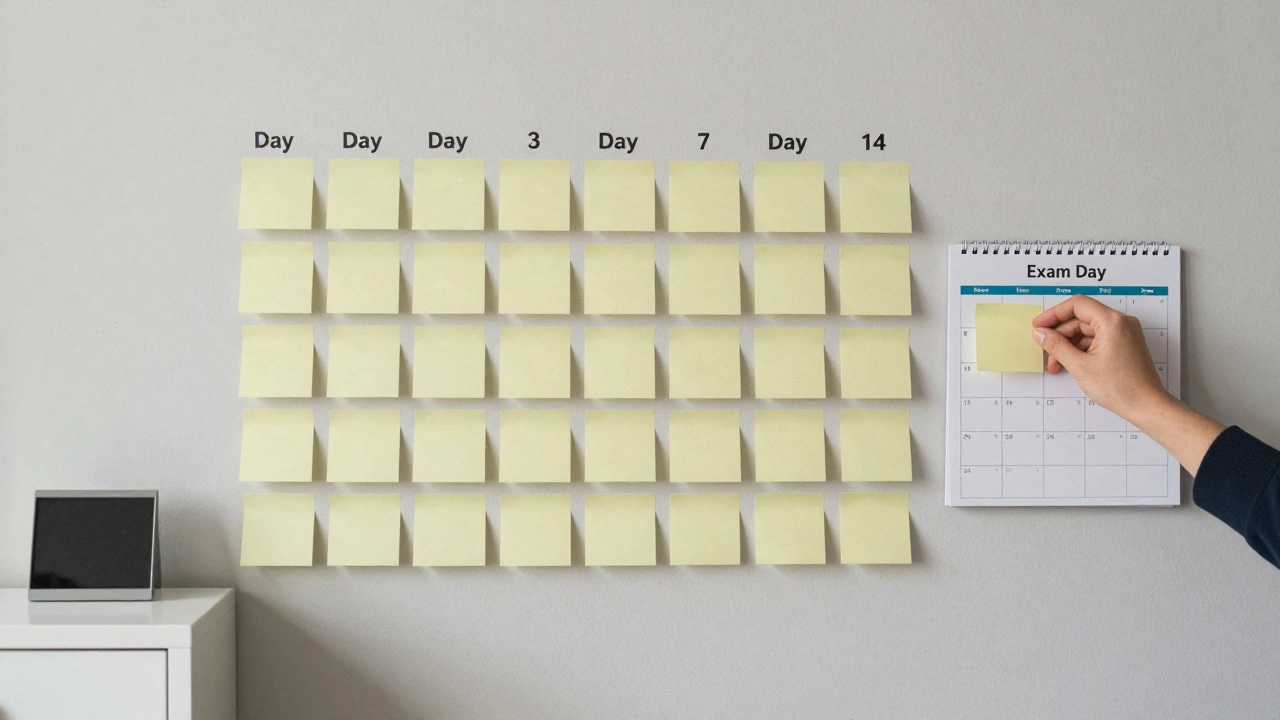
Tools like Anki automate this, but you can do it manually. Write each topic on a sticky note. Put it on your mirror. Move it to your desk after you recall it. Move it to a drawer after you nail it twice. You’re building your own spaced system.
Memory palace? It’s powerful-but not for everyone
You’ve heard of the memory palace. Ancient Greeks used it. Memory champions still do. It involves mentally placing facts in a familiar location-like your house. Each room holds a different concept. Walk through it mentally to recall.
It works. A 2017 study in Neuron found that after six weeks of memory palace training, participants doubled their recall ability. But here’s the catch: it takes time to learn. You need to visualize, associate, and navigate mental spaces. For a student cramming for a GCSE science exam next week? It’s overkill.
Use the memory palace if you’re memorizing long lists-like anatomy terms, historical dates, or legal codes. For most exam prep? Stick with active recall + spaced repetition. It’s simpler, faster, and just as effective.
Why mnemonics and acronyms fall short
“ROY G. BIV” for rainbow colors? Clever. But what happens when you need to explain why red light bends less than violet? Mnemonics help with surface-level recall, not understanding. They’re shortcuts, not deep learning.
A 2020 study in Memory & Cognition found that students using mnemonics scored higher on memorization tasks-but lower on application questions. They remembered the fact, but couldn’t use it. Exams don’t just ask “What is photosynthesis?” They ask, “Explain how light intensity affects the rate of photosynthesis.”
So use mnemonics sparingly. Only for names, dates, or formulas you can’t logically connect. Don’t rely on them for core concepts.
The real secret: retrieval practice over time
The best memory technique isn’t one trick. It’s the combo: active recall + spaced repetition. Together, they turn short-term memory into long-term knowledge. No magic. No gimmicks. Just science.
Here’s a simple weekly plan for exam prep:
- Day 1: Learn new material. Take notes.
- Day 2: Close notes. Test yourself. Write down what you remember.
- Day 4: Review weak spots. Test again.
- Day 7: Do a full quiz-no notes.
- Day 14: Re-test everything. Focus on what you missed.
- Day 21: Final review. Sleep well before the exam.
That’s it. No need for 10-hour study days. Just 20 minutes of active recall, spaced out. Students using this method in a 2023 trial improved their exam scores by an average of 28% compared to those who reread or highlighted.
What to avoid
Don’t study passively. Don’t wait until the night before. Don’t confuse highlighting with learning. Don’t think more hours = better results. Your brain doesn’t work like a hard drive. It works like a muscle. It needs stress, rest, and repetition to grow.
Also, don’t get distracted by flashy apps or YouTube videos promising “memory hacks.” Most are just repackaged active recall with bells on. The core method hasn’t changed since the 1930s. And it still works better than anything new.
Final takeaway
The best memory technique for exam prep isn’t the flashiest. It’s the most consistent. Test yourself. Space it out. Repeat. That’s it. You don’t need a genius brain. You just need to stop fooling yourself into thinking you know something because you’ve seen it before. True memory isn’t about recognition. It’s about retrieval. And you’re capable of it-just not with the methods you’ve been using.
Is active recall better than rereading notes?
Yes, by a wide margin. Studies show active recall improves long-term retention by up to 50% compared to rereading. Rereading creates familiarity, not memory. Active recall builds retrieval strength-exactly what exams test.
How often should I review material for best results?
Review just before you’re about to forget. Start with 1 day, then 3 days, then 1 week, then 2 weeks, then 1 month. This spacing pattern is backed by decades of cognitive research. The key is not cramming-it’s timing.
Do I need Anki or other apps to use spaced repetition?
No. Apps like Anki help automate spacing, but you can do it with paper flashcards, sticky notes, or even a calendar. The tool doesn’t matter. What matters is testing yourself at increasing intervals.
Can memory palaces help with math or science exams?
They can help with memorizing formulas or lists, but not for understanding concepts. For math or science, focus on active recall of problem-solving steps. Understanding how to apply a formula matters more than memorizing it.
Why does testing myself work better than just reading?
Because recalling information forces your brain to reconstruct the memory. This strengthens the neural connections. Reading just activates them briefly. Testing rebuilds them-making them stronger and easier to access later.