GCSE to US Grade Converter
If you’re looking at GCSEs and wondering how they line up with the American school system, you’re not alone. Thousands of international students, families moving to the US, and even US colleges trying to understand foreign qualifications ask this same question every year. The short answer? GCSEs are most similar to the end of 10th grade in the US - but the comparison isn’t perfect. Here’s what you really need to know.
What Are GCSEs, Really?
GCSEs - General Certificate of Secondary Education - are the main exams taken by students in England, Wales, and Northern Ireland around age 16. Most students take between 8 and 10 subjects, including core ones like English, Maths, and Science, plus options like History, Art, or Computer Science. Exams are graded from 9 to 1, with 9 being the highest. A grade 4 is considered a standard pass, and a grade 5 is a strong pass. These grades matter for moving on to A Levels, vocational courses, or apprenticeships.
Unlike the US, where students are graded continuously throughout the year, GCSEs are mostly decided by final exams. That means one test can make or break a student’s grade. It’s high-stakes, and it’s designed to measure what a 16-year-old has learned after 11 years of school.
How US High School Works
In the United States, high school runs from 9th grade (age 14-15) to 12th grade (age 17-18). There’s no single national exam at the end of 10th grade. Instead, students earn credits by passing individual courses. Each class - say, Algebra I or Biology - typically lasts a year and gives 1 credit. To graduate, most states require about 20-24 credits across subjects like English, Math, Science, Social Studies, and electives.
US schools don’t have one big exam like GCSEs. Instead, they rely on classwork, homework, quizzes, projects, and final exams that are set by the teacher or district. There’s also the SAT or ACT, but those are college entrance exams taken in 11th or 12th grade - not end-of-year school exams.
GCSEs vs US 10th Grade: The Real Match
When US colleges and admissions officers look at GCSEs, they usually treat them as equivalent to the completion of 10th grade. That’s because both mark the end of a foundational education phase before students specialize. After GCSEs, UK students choose to focus on 3-4 A Level subjects. In the US, students pick more advanced courses in 11th and 12th grade - AP classes, honors tracks, or electives.
Think of it this way: if a US student finishes 10th grade with passing grades in English, Math, Science, and History, they’ve covered roughly the same breadth as a GCSE student who passed those core subjects. The difference? GCSEs are standardized across the country. US grading varies wildly from state to state - and even school to school.
Grades: How Do GCSE Grades Translate?
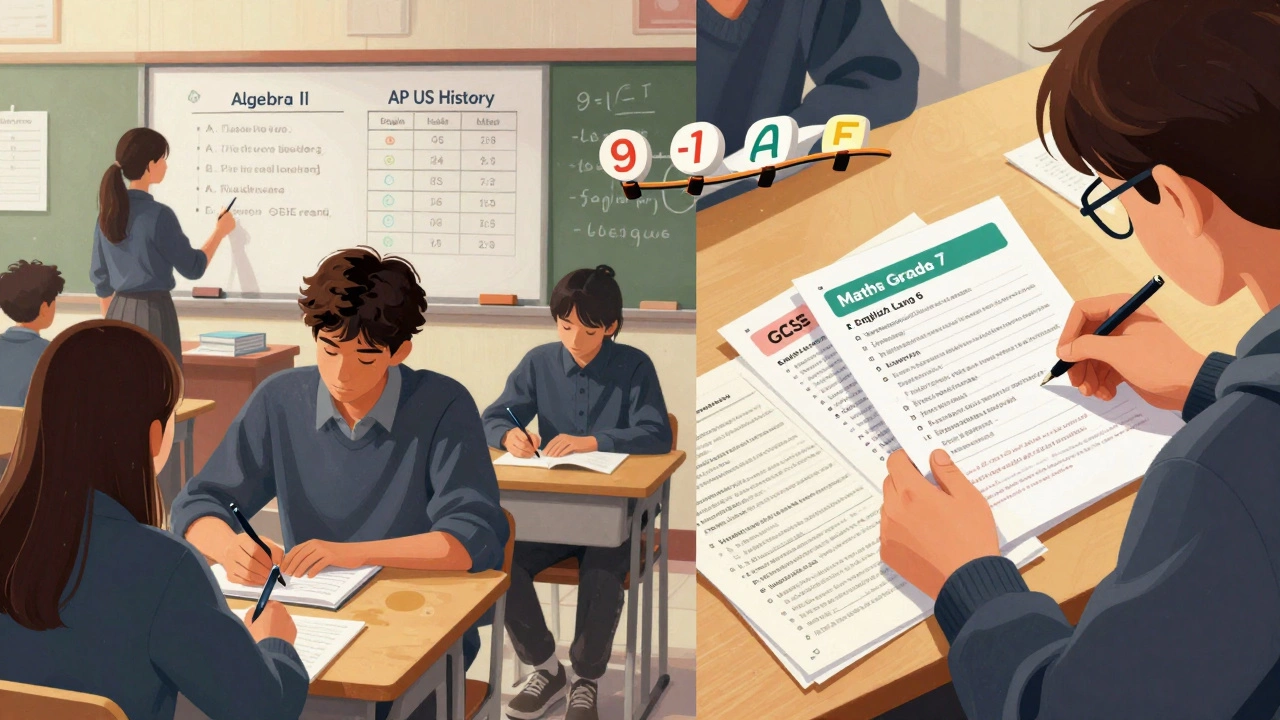
There’s no official conversion chart, but US institutions often use this rough guide:
- GCSE 9-7 (A*-A) = A in US high school
- GCSE 6-5 (B) = B
- GCSE 4 (C) = C
- GCSE 3 or below = D or F
Some US universities, especially competitive ones, look closely at GCSE grades in the context of the whole application. A student with five GCSEs at grade 7 or higher - including English and Math - is often seen as academically strong. That’s similar to a US student with straight A’s in core subjects by the end of sophomore year.
But here’s the catch: US colleges care more about what you did in 11th and 12th grade. GCSEs are a starting point. They help show your foundation, but they don’t decide your future.
What About the SAT or ACT?
Don’t confuse GCSEs with the SAT or ACT. Those are not equivalents. The SAT and ACT are college entrance tests taken by US students in 11th or 12th grade. They test reading, writing, and math - but not science, history, or literature in depth. GCSEs cover a much wider range of subjects and require deeper subject knowledge.
For example, a UK student with a GCSE in Biology has studied cells, genetics, evolution, and human physiology over two years. A US student might take a biology class in 9th or 10th grade, but they won’t be tested on it in the SAT. The SAT just checks basic math and reading skills.
If you’re applying to US colleges with GCSEs, you’ll still need to take the SAT or ACT. GCSEs show your academic background. The SAT/ACT shows you can handle the kind of reasoning those tests demand.
What Do US Colleges Actually Do With GCSEs?
Most US colleges have international admissions teams who know how to interpret GCSEs. They don’t need a perfect match - they look at the full picture. That includes:
- Number of GCSEs taken
- Grades in core subjects (English, Math, Science)
- Performance in challenging subjects (like Further Maths or Physics)
- What comes next - A Levels, IB, or vocational qualifications
For example, a student with 8 GCSEs at grade 7 or higher, plus 3 A Levels at A*, is seen as a top applicant. That’s roughly equivalent to a US student with straight A’s in honors and AP courses by senior year.
Some universities even have specific guidance. The University of California system, for instance, says GCSEs are acceptable as proof of completion of secondary education - but they expect students to continue with advanced coursework afterward.
What If You’re Moving to the US?
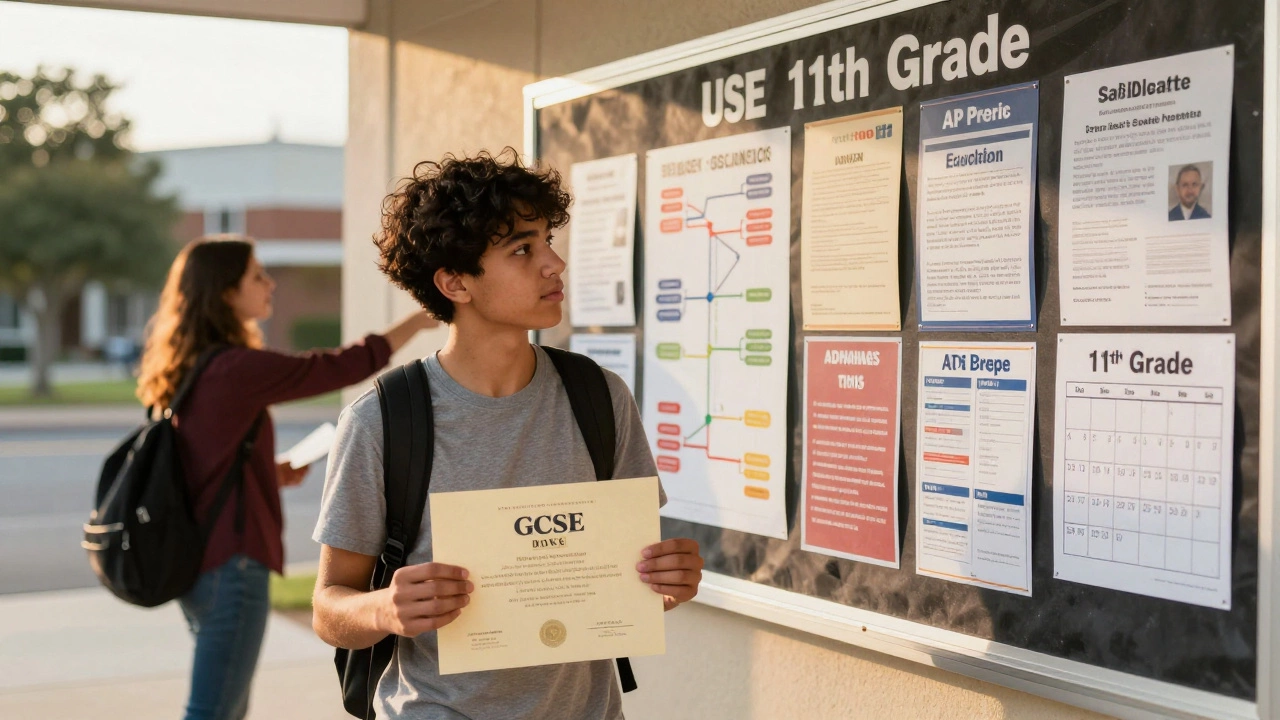
If you’re relocating from the UK to the US with GCSEs in hand, you’ll likely be placed into 11th grade. That’s because you’ve completed the equivalent of 10th grade. Your school will review your GCSE grades and transcripts to decide which classes you can skip or get credit for.
For example, if you got a grade 7 in GCSE Maths, you might be placed directly into Algebra II or Pre-Calculus instead of starting with Algebra I. Same with Science - a strong grade in Combined Science or Triple Science could let you skip Biology or Chemistry and jump into Physics or AP Environmental Science.
But don’t assume your GCSEs will automatically count. You’ll need to provide official transcripts, and sometimes schools will ask you to take placement tests. Always contact the school ahead of time.
Why This Matters for Future Plans
If you’re planning to go to university - whether in the UK, US, or elsewhere - understanding where GCSEs fit helps you plan better. You can’t just rely on GCSEs to get into a top US college. But they’re a strong foundation. Students who do well in GCSEs and then push themselves in A Levels or IB tend to have the strongest applications.
For US-based students considering studying in the UK, the reverse is true: your high school diploma and SAT scores will be seen as roughly equivalent to GCSEs plus A Levels. But UK universities expect you to have taken challenging courses - so taking AP classes or honors courses in high school matters just as much as your grades.
What’s Missing From the Comparison?
One big thing: the UK system is more specialized by 16. The US system stays broad until graduation. That means a UK student might stop studying History or Art after GCSEs. A US student keeps taking some version of those subjects through 12th grade.
Also, GCSEs are graded more harshly. Only about 20% of students get a grade 7 or higher in most subjects. In the US, A grades are more common - especially in schools with grade inflation. So a GCSE grade 7 is harder to earn than a US A.
And while US schools use GPAs, UK schools use individual subject grades. There’s no GPA for GCSEs. That makes direct comparisons tricky. Admissions officers learn to read the context - not just the numbers.
Final Takeaway
GCSEs are not a direct copy of any single US exam or grade level. But they’re best understood as the end of 10th grade - a milestone that shows you’ve mastered core subjects before moving into more advanced study. They’re not the full story, but they’re a solid starting point. Whether you’re applying to US colleges, moving schools, or just trying to make sense of your qualifications, remember this: GCSEs prove you’ve built a strong foundation. What you do after them - A Levels, AP classes, internships, projects - is what really opens doors.
Are GCSEs accepted by US colleges?
Yes, US colleges accept GCSEs as proof of secondary education completion. They’re especially useful for international applicants from the UK. However, colleges look beyond GCSEs - they want to see what you did after, like A Levels, IB, or AP courses. Strong GCSE grades help, but they’re not enough on their own.
Do US high schools give credit for GCSEs?
Some US high schools do give credit for GCSEs, especially for core subjects like English, Math, and Science. If you scored a grade 7 or higher, you might be placed into a higher-level class - like skipping Algebra I and going straight to Algebra II. But it’s not automatic. You’ll need to provide official transcripts and sometimes take a placement test.
Is a GCSE grade 4 the same as a passing grade in the US?
A GCSE grade 4 is considered a standard pass in the UK. In the US, that’s roughly equivalent to a C grade. Most US high schools require a C or better to earn credit for a course. So yes - a grade 4 meets the minimum threshold for credit transfer in most cases.
Do I need to take the SAT if I have GCSEs?
Yes, you’ll still need to take the SAT or ACT if you’re applying to US colleges. GCSEs show your subject knowledge, but the SAT/ACT tests the specific reasoning and critical thinking skills those exams measure. US colleges expect both - your GCSEs for background, and your SAT/ACT for standardized comparison.
Can I use GCSEs to apply to US community colleges?
Absolutely. Community colleges in the US are often more flexible with international qualifications. Many will accept GCSEs as proof of high school completion, especially if you have at least five passes including English and Math. You may still need to take placement tests for English or Math, but you won’t need SAT scores to enroll.